

Explaining, convincing and proving
-
-
 article
Transitivity
Suppose A always beats B and B always beats C, then would you expect A to beat C? Not always! What seems obvious is not always true. Results always need to be proved in mathematics.
-
 article
Continued Fractions II
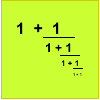
In this article we show that every whole number can be written as a continued fraction of the form k/(1+k/(1+k/...)).
-
 article
Fractional Calculus III
Fractional calculus is a generalisation of ordinary calculus where you can differentiate n times when n is not a whole number.
-
 article
Sperner's Lemma
An article about the strategy for playing The Triangle Game which appears on the NRICH site. It contains a simple lemma about labelling a grid of equilateral triangles within a triangular frame.
-
 article
Euler's Formula and Topology
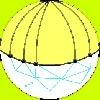
Here is a proof of Euler's formula in the plane and on a sphere together with projects to explore cases of the formula for a polygon with holes, for the torus and other solids with holes and the relationship between Euler's formula and angle deficiency of polyhedra.
-
 article
A Computer Program to Find Magic Squares
This follows up the 'magic Squares for Special Occasions' article which tells you you to create a 4by4 magicsquare with a special date on the top line using no negative numbers and no repeats.
-
 article
An Alphanumeric
Freddie Manners, of Packwood Haugh School in Shropshire solved an alphanumeric without using the extra information supplied and this article explains his reasoning.
-
 article
Powerful Properties
Yatir from Israel wrote this article on numbers that can be written as $ 2^n-n $ where n is a positive integer.
-
 article
The Kth Sum of N Numbers
Yatir from Israel describes his method for summing a series of triangle numbers.