

Whirlyball

 2 out of 3
Whirl a conker around in a horizontal circle on a piece of string. What is the smallest angular speed with which it can whirl?
Problem
See video [mediaplayer avi - 3.4MB] [quicktime - 0.5MB] [ipod - 1.3MB]

A ball of mass $m$ is attached to a light inextensible string of length $l$. The ball is whirled around so that it moves in a horizontal circle with constant angular speed $\omega$.
Find the angle $\theta$ between the string and the vertical. Show that the angle $\theta$ is given by $\cos^{-1}{g\over l\omega^2}$.
Now increase the angular velocity. What happens to the ball?
What is the smallest angular velocity with which the ball can whirl in a circle on the end of the string in this way?
Getting Started
You can try this with a conker on a string. It is just motion in a circle with constant angular speed $\omega$. Remember that the acceleration towards the centre is $r\omega ^2$ where $r$ is the radius of the circle. Resolving horizontally use 'force = mass times accelaration'.
Student Solutions
Andrei from Tudor Vianu National College, Bucharest, Romania and Shaun from Nottingham High School both sent in excellent solutons to this problem.
Image
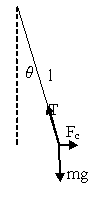
| After drawing the picture, I observed that the forces (the gravitational force acting on the ball, the tension in the wire and the centrifugal force) keep the body in equilibrium. Considering the centrifugal force, I work in a non-inertial frame of reference, i.e. in the frame centred on the ball, which is in an accelerated movement in respect to Earth.
In terms of the vectors we have $$m g + F_c + T = 0.$$ |
Resolving horizontally and vertically and using $F=ma$ (where $a$ is the acceleration towards the centre and $T$ is the magnitude of the tension in the string):
$$
\begin{align}
T\cos \theta &= mg\\
T\sin \theta &= ml\sin \theta \omega^2\;.
\end{align}
$$
Eliminating $T$: $$l\omega^2 \cos \theta = g$$ and hence the angle $\theta$ is $\cos^{-1}{g\over l\omega^2}$.
I know that $\cos^{-1}$ is a decreasing function in the interval of interest for the problem. As $\omega$ increases, the angle $\theta$ also increases and the whirling ball rises up, the radius of its circular path also increasing.
The ball can whirl in a circle while $\theta > 0$. So, as I explained above, to find the smallest angular velocity, I have to find the smallest angle. For $\theta \to 0$, ${g\over l\omega^2}\to 1$ and so $$\omega \to \sqrt {g\over l}.$$ This is the smallest angular velocity with which the ball could rotate in a circle.
The period of this movement is: $$T = {2\pi \over \omega} = 2\pi \sqrt {l\over g}.$$ It is interesting to observe that this is also the period of isochronal oscillations of the mathematical pendulum, i.e. the period of oscillation of a material point of mass $m$ attached to an inextensible string without mass deviated from the vertical by angles less than $5^\circ$.
Teachers' Resources
An experiment in circular motion using a conker on a string.
The introductory video of 'Shaggy' whirling his conker was created with a program that includes a simulation engine for Newtonian mechanics. We used this engine to animate the conker and its string - so the resulting motion is in a sense 'real'.
Shaggy's hand drives the string. Its motion was defined using trigonometric functions of time applied to the various joints that make up the Shaggy model. In the final 5 seconds the hand moves with exactly half the frequency of the motion which set the conker whirling initially. Its amplitude is however unchanged.