

Neighbours

 2 out of 3
In a square in which the houses are evenly spaced, numbers 3 and 10 are opposite each other. What is the smallest and what is the largest possible number of houses in the square?
Problem
In a square in which the houses are evenly spaced around the outside, numbers $3$ and $10$ are opposite each other.
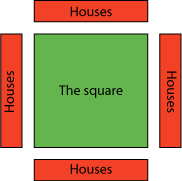
What is the smallest number of houses in the square?
What is the largest possible number of houses in the square?
Getting Started
If the houses are evenly spaced, what do you know about the total number of houses?
Where could house number $1$ go?
Have you thought of drawing a picture?
Student Solutions
Pupils from Town Close House in Norwich sent in these pictures of the work done by many of the pupils working together. Well done, some lively ideas.
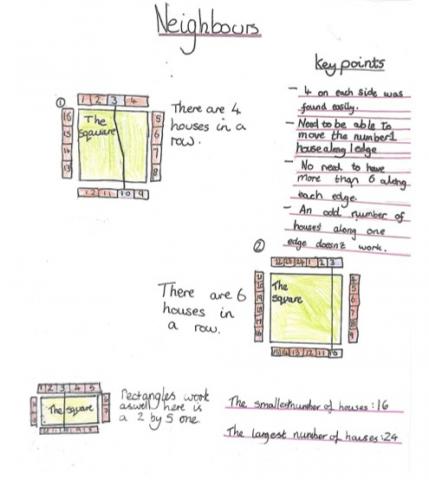
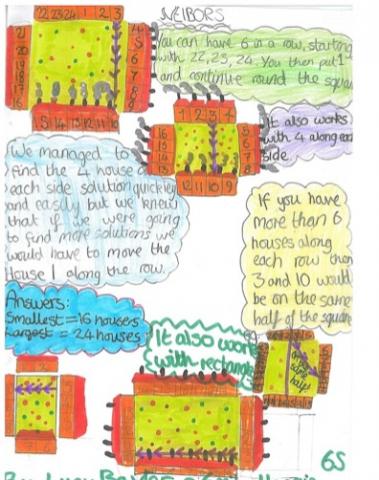
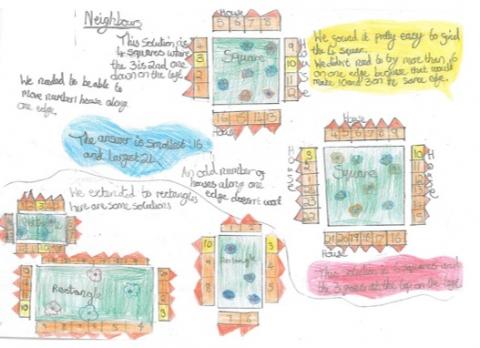
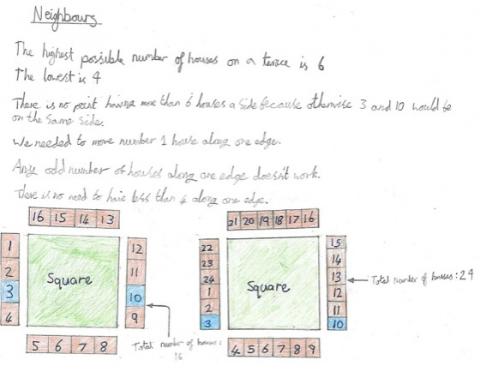
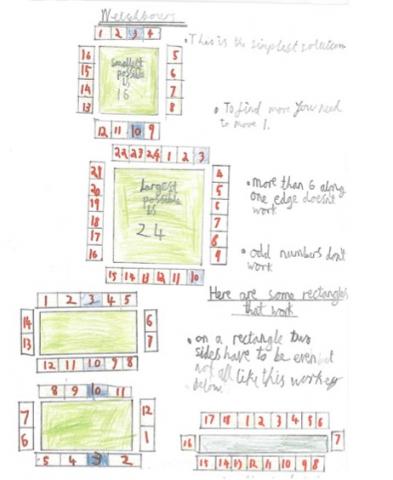
Just to finish and say that there were a lot of good solutions. I particularly liked the solution from Amy from Archbishop Beck's School. She suggested that the odds and evens were separated so in a 3×3 square the houses went 1 ,3, 5, 7, 9, 11, 12, 10, 8, 6, 4, 2 clockwise around the tiny square!
James also solved the problem in very creative way. He says:
You're right, James, we didn't say that the house numbers were in numerical order so I think your solution would definitely work. Well done!
Teachers' Resources
Using NRICH Tasks Richly describes ways in which teachers and learners can work with NRICH tasks in the classroom.
Why do this problem?
Possible approach
Key questions
Possible extension
Encourage learners to explore other combinations of house numbers. How about $17$ and $59$ being opposite each other? Pupils could also ask their own 'what if ...?' questions. For example, what would happen if the houses were arranged in a rectangle rather than a square?
Possible support