

Cyclic Triangles
 3 out of 3
Make and prove a conjecture about the cyclic quadrilateral inscribed in a circle of radius r that has the maximum perimeter and the maximum area.
Problem
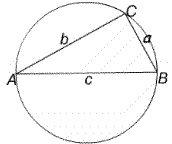
A triangle $ABC$ is inscribed in a circle with $AB$ as diameter. Find the maximum value of $AC + CB$.
Now generalise your result to the case where $AB$ is fixed but not a diameter of the circle.
Make and prove a conjecture about the cyclic quadrilateral inscribed in a circle of radius $r$ that has the maximum perimeter and the maximum area.
Getting Started
Think about what stays the same and what changes if you fix $c$ and vary $a+b$.
For the first part you have a right-angled triangle so you might try to use Pythagoras' Theorem which suggests working with $(a+b)^2$. The key idea is to maximise the area of the triangle.
To generalise this go from Pythagoras' Theorem to the Cosine Rule. Again use the area of the triangle. The key idea here is that if you fix $c$ and vary $a+b$ the angle $\angle ACB$ is constant.
The last part calls for a careful argument based on four applications of the second result.
Student Solutions
Congratulations to Curt, Reigate College and to Andrei, Tudor Vianu National College, Bucharest, Romania for you solutions to this problem
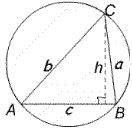
When AB is a diameter angle $ACB$ is 90 degrees so we can use Pythagoras' Theorem. The area of the triangle is given by $\textstyle{1\over 2}ab = \textstyle {1\over 2}ch$ where $h$ is the length of the perpendicular from $C$ to $AB$. Then
$$(a+b)^2=a^2+b^2+2ab=c^2+2ch.$$
Thus $(a+b)^2$ is a maximum when $h$ is a maximum and equal to the radius of the circle $\textstyle {1\over 2}c$ . So the maximum value of $a+b$ is $c\sqrt 2$.
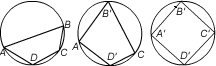
Labelling $Q$ as $ABCD$, consider triangle $ABC$ with $AC$ fixed and $B$ varying. Let $B'$ be the position of $B$ when, by the previous result $AB + BC$ is a maximum, that is when $AB = BC$ Note that this also gives the maximum area of triangle $ABC$. Similarly by considering triangle $ADC$ with $AC$ fixed, we find $D'$ where $AD+DC$ is a maximum and $AD=DC$. Now $B'D'$ is a diameter, keep this fixed and consider triangles $B'CD'$ and $B'AD'$. The positions of $C$ and $A$ that maximise the perimeter and area are $C'$ and $A'$ where $A'C'$ is a diameter. Hence, for the perimeter and area of $Q$ to be a maximum all the sides of the quadrilateral must be equal making $Q$ a square. Hence the maximum perimeter is $4r\sqrt 2$ and the maximum area is $2r^2$.
Teachers' Resources
The three parts of this question build on each other and require careful arguments based on simple algebra, geometry and trigonometry.