

Poly Plug Rectangles

 1 out of 3
The computer has made a rectangle and will tell you the number of spots it uses in total. Can you find out where the rectangle is?
Problem
In this activity, the monkey secretly makes a rectangle using equal rows of spots on the 5 by 5 grid.
The aim is for you to find the rectangle by testing spots on the interactivity below.
Once you think you know where the monkey's rectangle is, click the 'Ready' button.
Which spot is a good one to test first? Why?
If you had to use as few test spots as possible, how would that change the way you play?
Are there some total numbers of spots that are easier than others?
This problem was inspired by Doug Williams' Poly Plug resource.
Getting Started
Student Solutions
Thank you to everybody who sent us their ideas about how to find the monkey's rectangle. You can see some videos of children working on this task in our Early Years Children's Thinking section.
Sion from Twyford School in England sent in this strategy:
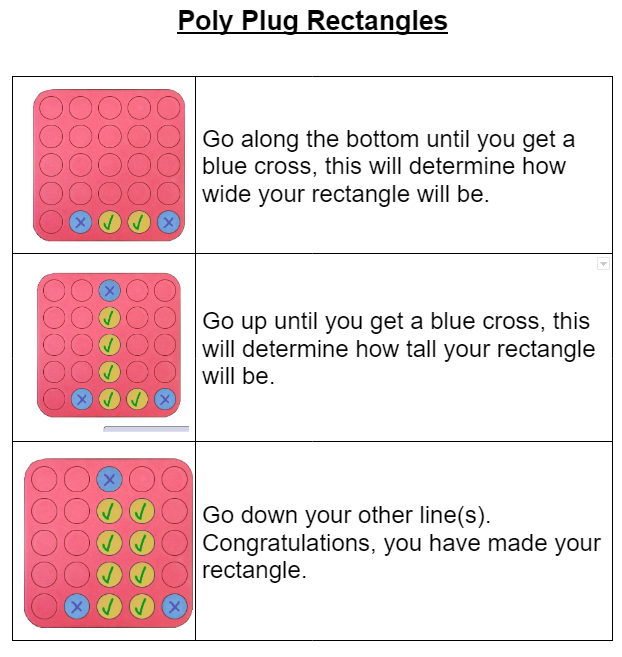
Well done, Sion - I agree that this strategy will always work!
I wonder if there's a way that Sion could change this strategy to use fewer test spots?
Louis from Prospect House School in England sent in this picture of the grid:
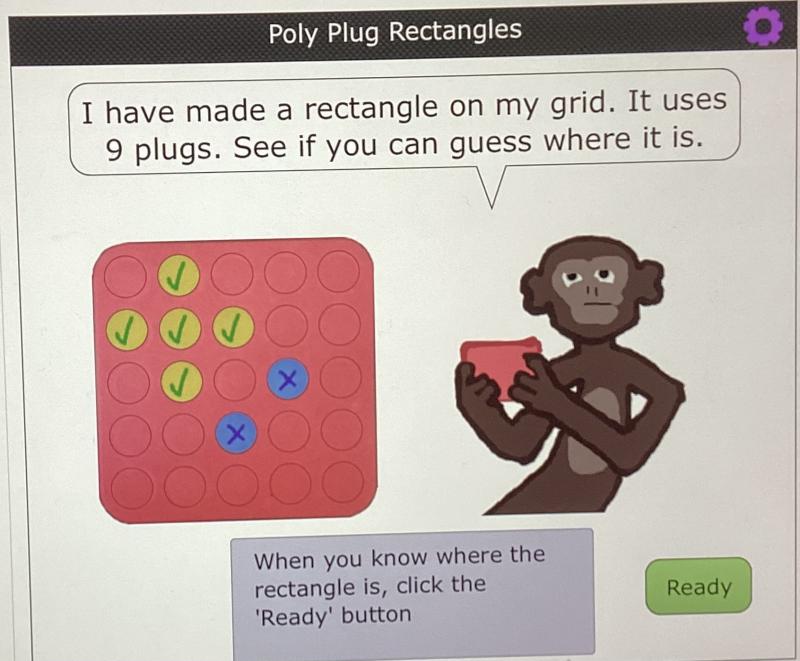
Thank you for sending in this picture, Louis. Can you see where the rectangle will be? The rectangle in this grid is actually a special type of rectangle - what other name do we have for rectangles like this one?
If we didn't have the monkey's clue about how many plugs are used in the rectangle, could we still work out exactly where the rectangle will be using Louis's test spots? Why or why not?
We thought you might also like to see these sketches, drawn by a member of the NRICH team as he was working on a new interactivity for this task:
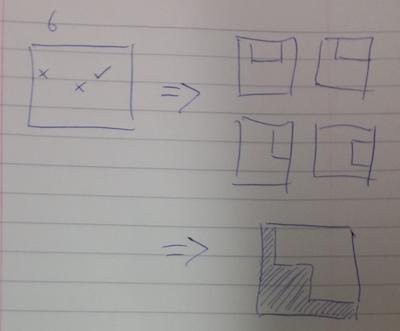
What might he be thinking?
If you would like to get in touch with us about how you approached this task, please email us with your ideas.
Teachers' Resources
Using NRICH Tasks Richly describes ways in which teachers and learners can work with NRICH tasks in the classroom.
Why do this problem?
This low threshold high ceiling problem reinforces children's knowledge of the properties of a rectangle. It also provides opportunities for them to make hypotheses, explain their reasoning and test out their ideas.
As with most NRICH problems, we 'roadtested' this with a class of real children. You can see annotated videos of our attempts below. We learnt a lot ...
Possible approach
This problem featured in an NRICH video in June 2020.
If you have sets of Poly Plugs please follow version 1 below. If not, version 2 will be more appropriate.
Version 1
If this is the first time the children have handled Poly Plug, give them time to play (we found 15 minutes was about right). Observe what learners do and comment on anything mathematically interesting, drawing out ideas such as repeating patterns, symmetrical patterns, pictures etc.
Then, in pairs, ask children to take out all the red plugs and count out six blue/yellow plugs. What can they make using their six plugs? Share interesting ideas, and finish by drawing out the idea of a rectangle of six plugs, perhaps by showing a rectangle someone has made.
Show the interactivity and click 'Start' until the computer has chosen a rectangle made of six plugs. Explain that the computer has chosen a rectangle using six plugs (or spots). Can we find out where it is? Tell the group that when they test a plug, it will turn yellow if, yes, it is part of the rectangle but blue if, no, it isn't part of the rectangle.
Invite children to identify a plug to test. Click on the chosen plug and reinforce whether it is or isn't in the rectangle. At this stage don't worry about the reasoning. Every so often ask, "Do we know where the rectangle is?". When this is certain, check on the right-hand grid. (This itself can be a challenge as the children transfer the rectangle from one grid to the other.)
Repeat with a new rectangle of six plugs, this time asking for a justification for each plug to test. Listen for explanations that indicate the children are visualising the possible locations of the rectangle. You may have some sophisticated thinking where rather than confirming what they know, children test one of two or more possibilities. (If appropriate emphasise that we're looking at filled rectangles, not just outlines.)
With a child, model the same activity using the Poly Plug so that one of you secretly visualises a rectangle of six plugs on the blank red grid and the other points to the holes to test. The blue/yellow plugs are used to confirm. Give the children some time to play this in pairs. You may want to challenge them to discover the rectangle in as few plugs as possible.
Having had a go with six plugs, children could choose the number of plugs their rectangle contains.
Version 2
Either individually or in pairs, give children a copy of this large 5 by 5 grid and a selection of counters. Invite them to make a pattern on the grid using any number of counters. Observe what learners do and comment on anything mathematically interesting, drawing out ideas such as repeating patterns, symmetrical patterns, pictures etc.
Then ask learners to make something using exactly six counters of any colours. Share interesting ideas and finish by drawing out the idea of a rectangle of six plugs, perhaps by showing a rectangle someone has made.
Click on the settings button of the interactivity and select '6' in the size menu, then click the button which says 'Restart the activity with these settings'. Show the interactivity to the class and explain that the monkey has chosen a rectangle using six spots. Can we find out where it is?
Invite children to identify a spot to test. Click on the chosen spot and reinforce whether it is or isn't in the rectangle. At this stage don't worry about the reasoning. Every so often ask, "Do we know where the rectangle is?". When this is certain, click on the 'Ready' button. (You can change your mind and continue to test spots.) The monkey then invites you to show where the rectangle is on a new grid. (If this guess is not correct, you are allowed one more guess having had more time testing spots.)
Repeat with a new rectangle of six spots, this time asking for a justification for each plug to test. Listen for explanations that indicate the children are visualising the possible locations of the rectangle. You may have some sophisticated thinking where rather than confirming what they know, children test one of two or more possibilities. (If appropriate, emphasise that we're looking at filled rectangles, not just outlines.)
With a child, model the same activity using the large paper grid so that one of you secretly visualises a rectangle of six counters on the blank grid and the other points to the holes to test. Sets of two different coloured counters can be used to confirm (e.g. blue is no, yellow is yes). Some children might find this sheet of six blank grids useful. They could use it to record their own rectangle so that they don't need to rely on visualisation. Give the children some time to play this in pairs. You may want to challenge them to discover the rectangle in as few counters as possible.
Having had a go with six counters, children could choose the number of counters their rectangle contains.
Key questions
What shape is this? How do you know?
What can we say about a rectangle?
Where could the rectangle be? How do you know?
Where can't the rectangle be? How do you know?
Which plug/spot shall we test now? Why?
Possible extension
Learners could play a version of the game in pairs which allows diagonal rectangles too.
Possible support
This sheet contains six different rectangles each using six plugs which could be used if children find it difficult to imagine their own. The sheet could be cut up into six cards and the child creating the rectangle could choose one card without showing it to his/her partner. Alternatively, all six cards could be visible to both players all the time for comparing and checking.
Annotated videos
With thanks to Class Two children and teachers at Bourn Primary School.
Clip 1 (above): We gave the children some time to play with the Poly Plugs as these were new to them. Not all used them to make patterns within the grid but almost everything was mathematical! There was a lot of noise, most of it productive, and our feeling was that if we hadn't given them this time, they would not have been so focused later on.
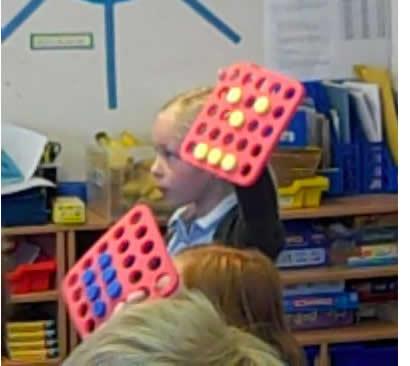
Picture 2: Having given them time to play freely, we then suggested they make any pattern or picture they like using just six plugs. We used this child's pattern to draw out the properties of a rectangle.
Clip 3 (above): We then introduced the class to the interactivity. (The interactivity has since been updated so looks a little different now.) We made the mistake of using a rectangle of four plugs, rather than building on the work they'd just done using six plugs to make a rectangle. You can see the difference in their reactions in this clip and clip 4 which does use six plugs. We re-wrote these teachers' notes after this experience.
Clip 4 (above): In this clip, we encourage the children to find the rectangle more quickly and this time it contains six plugs.
Clip 5 (above): We were keen that the children should share their thinking. It was interesting, but unsurprising, that they were disappointed when a plug turned blue.
Clip 6 (above): In this clip, we confronted their keenness to choose only positive examples, trying to help them to see that a blue plug could give them far more information than a yellow one. We're not sure we won though!