

A Different Look at Polygons

 2 out of 3
This task is looking at creating polygons with specific lengths. Also, there's a chance to explore symmetry.
Problem
These are the five triangles you can make out of 13 rods, each rod the same length.
These are the triangle measurements: 6,6,1; 6,5,2; 6,4,3; 5,5,3; 5,4,4.
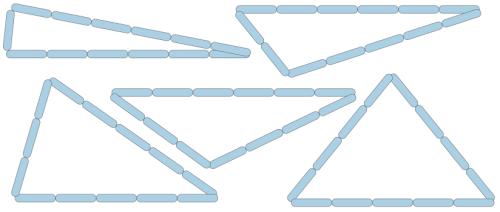
I had to avoid reflections and rotations that use the same measurements.
Your Challenge
Use rods of the same length, string etc. to explore some of the following ideas
1/ Using 10, 11 or 12 units
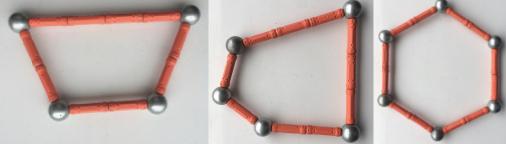
Using these numbers of units you could explore making a quadrilateral, a pentagon and a hexagon. Maybe you would find a kind of system to help?
2/ Other Triangles
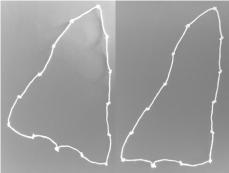
I had used some magnetic rods and spheres to help with some but here I used a string with equal spaced knots. Maybe you could also find something to help? If you had 16 lengths instead of the 14 shown here how many different triangles can you make using all 16 each time? Maybe you would find a kind of system to help?
3/ You could look at just pentagons and use 10, 11 or 12 units
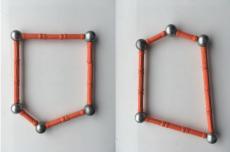
Here are two to start you off. I wonder if you can find them all with no repeats.
4/ You could look at only symmetric hexagons and use 10, 11 or 12 units
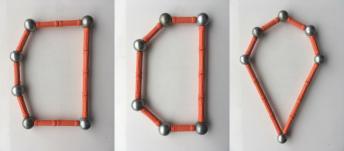
Here are three to start you off. I wonder if you can find them all with no repeats.
Teachers' Resources
Using NRICH Tasks Richly describes ways in which teachers and learners can work with NRICH tasks in the classroom.
Why do this problem?
This activity involves looking, exploring and thinking all in the process of being curious. The further pupils progress through the activity, the greater the opportunities for pupils to ask themselves "I wonder what would happen if... ?"
Children's curiosity when working on this activity can take them to many different places both spatial and numerical. The children's perseverance can be witnessed by the teacher, the activity helping the pupils to persevere to search for more different examples based on the starting place. While they are working on their explorations there is present the catalyst for resilience being developed by each pupil.
Possible approach
Because this activity was put together to give pupils the opportunity to use their curiosity, there is little for the leader/teacher to do to introduce the activity, except to take pressure off and say that anything that comes to their mind to follow is ok.
Key questions/prompts
Tell me what you are doing?
There might be another way of looking at this
Possible extension
Allow them to answer their questions related to "I wonder what would happen if I... ?"
Possible support
You may need to supply appropriate materials.
It may be appropriate to link one pupil with another.