

Maximum Scattering

 2 out of 3
Your data is a set of positive numbers. What is the maximum value that the standard deviation can take?
Problem
Image
| a) The data obtained from a given experiment is a pair of numbers $a$ and $b$, where $a\geq 0$ and $b\geq 0$. It is known that $a$ and $b$ have mean $1$; what is the largest value that the standard deviation can be?
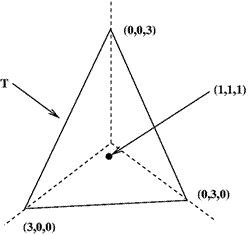
(b) The data obtained from a given experiment is a triple of numbers $x$, $y$ and $z$, where each is non-negative. It is known that the mean of $x$, $y$ and $z$ is $1$; what is the largest value that the standard deviation can be? |
(c) The data obtained from a given experiment is a set of numbers $t_1,\ldots,t_n$, where each is non-negative. It is known that the mean of the $t_j$ is $1$. Show that the standard deviation may be as large as $\sqrt{n-1}$.
Getting Started
To work out the variance you have to sum the squares of the differences of all the numbers from the mean.
To do this question you could think of the set of numbers as a point in space and use geometrical reasoning to help you to decide which position(s) of the point gives the greatest variance. A 'special' point occurs where all the numbers in the set are equal to the mean. Can you see how the variance for any set of numbers relates to the distance of the corresponding point from the 'special' point?
The constraints that the mean of the numbers is given, and that the numbers are all positive, restrict the points to lie in a certain region.
Student Solutions
Ruth from Manchester High School for Girls sent us her work on this problem. Well done, Ruth!
Teachers' Resources
Having done the first two parts of the question you can show similarly that, with $n$ numbers, there exists a certain value of the variance and hence that the variance can be at least that large. It is quite a subtle point, but you can't be sure that you have found the largest value of the variance with $n = 4$ or more without assuming that the geometrical reasoning generalises from $3$ dimensions to higher dimensions. The results are in fact valid in $n$-dimensional geometry but you are not asked to prove this.