

Dotty Relationship

 2 out of 3
Can you draw perpendicular lines without using a protractor? Investigate how this is possible.
Problem
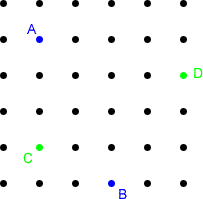
On the grid below, join the two blue dots, A and B, together with a straight line.
Now join the green dots, C and D, with a straight line.
Getting Started
You could use a protractor (angle measurer) to check the angle between the two lines.
Is is possible to start from a different point when you are drawing the lines?
Student Solutions
Thank you to those of you who sent in solutions.
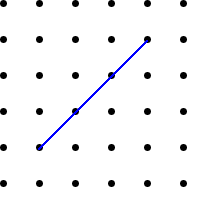
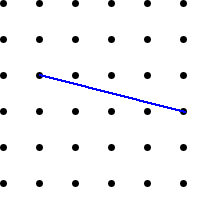
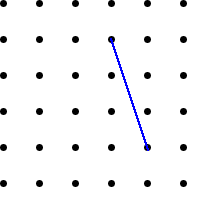
Several of you including Shuaib correctly identified that the lines AB and CD cross at $90$ degrees. Flora observes that the number of squares horizontally and vertically are swapped around when you draw a perpendicular line:
They are the same number of squares although the number of squares has been rotated.
Flora goes on to observe that there is more than one solution each time :
because perpendicular lines can be any distance apart.
Alden and Jimmy from Woodstock Primary correctly point out that :
They do not have to be the same length because they can be any length as long as it's a $90$ degree angle.
Teachers' Resources
Using NRICH Tasks Richly describes ways in which teachers and learners can work with NRICH tasks in the classroom.
Why do this problem?
This problem could be linked to coordinates. It could also form an introduction to vectors at a higher level. It is a powerful geometrical investigation. It has the potential to quickly lead to generalisations that pupils can apply in the second part of the question.
Possible approach
The notion of "how long is a line?" would form an excellent discussion point in the plenary.