

Isosceles Triangles

 1 out of 3
Draw some isosceles triangles with an area of $9cm^2$ and a vertex at (20,20). If all the vertices must have whole number coordinates, how many is it possible to draw?
Problem
Isosceles Triangles printable sheet
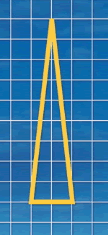
This question is about isosceles triangles with an area of 9 cm$^2$.
One of the vertices must be at the point (20, 20).
Each vertex of the triangle must be at a grid point of a square grid, so all the vertices will have whole number coordinates.
How many different triangles satisfy these four conditions?
Try to find them all. You may wish to use the GeoGebra applet below.
Can you explain how you know that you have found them all?
Click here for a poster of this problem.
Getting Started
Isosceles triangles have two equal sides.
The area of a triangle is half the base times the height.
Any of the three vertices of the triangle can be at $(20, 20)$.
There are sets of identical (congruent) triangles with an area of $9$cm$^2$.
How many triangles are there in each set? How many sets?
Student Solutions
We received a lot of partial solutions to this problem, but not many students managed to find every possible triangle.
Paula from Caxton College in Spain worked out the three possible shapes of the triangle using a formula for area:
To solve this problem, we use the triangle area formula: area = $\frac{1}{2}$ × base × height. Since the area is 9, the base × height must equal 18.
We then find all the pairs of numbers that multiply to 18, like 1 and 18; 2 and 9; and 3 and 6.
Lea and Zosia from Europa School in the UK noticed that these three pairs would give us six possible isosceles triangles, but some would not have vertices on whole number coordinates:
The area of a triangle is A = $\frac{hb}{2}$. Hence the height and base of the triangles with area 9 must multiply to 18. There are 6 triangles like this. However it cannot have an odd base otherwise some vertex would be off a point. 3 triangles remain: height 3 base 6, height 1 base 18 and height 9 base 2.
Yawin from St Faith's School in Cambridge, UK drew these three triangles, putting the top vertex at (20, 20) each time:

Lea and Zosia from Europa School realised that there must be more than three solutions, because each triangle can be moved and rotated. They explained:
For every triangle we can rotate it multiple times. Every vertex of the triangle can be at point (20, 20) and we can rotate it 90 degrees 4 times, therefore there are 3 (number of triangles) × 3 (number of vertices) × 4 (number of rotations) = 36 triangles.
This is correct - there are 3 triangles, each of which can be rotated in 4 different directions, and these 12 triangles can be translated so that each of the 3 different vertices are on (20, 20). This gives us 36 solutions, which Ci Hui Minh Ngoc from Kelvin Grove State College in Brisbane, Australia has drawn out on a coordinate grid. Take a look at Ci Hui Minh Ngoc's full solution to see all the different ways these triangles can be drawn.
We also received similar solutions from: Carson and Nicholas from Harrow International School in Hong Kong; Luis from Caxton College in Spain; Dhruv from The Glasgow Academy in Scotland, UK; Noah from St Augustine's Catholic Primary School in the UK; Sebastian from St Luke's Catholic College in Australia; Riaan from Australia; Lea and Zosia from Europa school in the UK; Lamees from Doha College in Qatar; Arin from Daegu International School in South Korea; and Julian from Nelson College Preparatory School in New Zealand. Thank you all for sharing your ideas with us.
Teachers' Resources
Using NRICH Tasks Richly describes ways in which teachers and learners can work with NRICH tasks in the classroom.
Why do this problem?
Paul Andrews, a respected mathematics educator based at Cambridge University, explains why he likes this problem :
I love it because it forces an acknowledgement of so many different topics in mathematics and is sufficiently challenging to keep almost any group meaningfully occupied within a framework of Key Stage Three mathematics content. This, for me, is the key to a good problem; Key Stage Three content alongside non-standard and unexpected outcomes.
For example, notwithstanding the obvious problem solving skills necessary for managing such a non-standard problem, I think it requires an understanding of coordinates, isosceles triangles and the area of a triangle. It requires an awareness of the different factors of 18 and which are likely to yield productive solutions. It requires, also, an understanding not only of basic transformations like reflection and rotation but also an awareness of their symmetries. Moreover, the solution, which is numerically quite small, is attainable without being trivial.
In short, I love this problem because of the wealth of basic ideas it encapsulates and the sheer joy it brings to problem solvers, of whatever age, when they see why the answer has to be as it is. It is truly the best problem ever and can provoke some interesting extensions."
Possible approach
This printable worksheet may be useful: Isosceles Triangles.
Show the class this triangle and ask them to list as many properties of the triangle as they can.
Group students into threes or fours.
Ask them to find some triangles that satisfy the following criteria:
- It is an isosceles triangle.
- The area is 9 square centimetres.
- Each vertex has whole number coordinates.
- One of the vertices is at (20, 20).
Once students have found a few examples, you may wish to use the interactive applet in the problem to check their work. Then challenge them to find all the possible triangles that satisfy the four conditions.
Make it clear that you will expect them to justify that they have found all possibilities.
Once groups feel that they have finished, they could try to explain clearly to the class why they are convinced they have found all of the solutions. Those who missed out solutions could be encouraged to think about why these solutions were overlooked.
Key questions
- How do you know that your triangles have the correct area?
- Are there any more like that?
- Can you explain why you are certain that there are no more solutions?
Possible support
Possible extension
Challenge students to find a general method for working out how many different isosceles triangles can be drawn for any given area (assuming we retain all the other constraints).