

Transforming the Letters

 1 out of 3
What happens to these capital letters when they are rotated through one half turn, or flipped sideways and from top to bottom?
Problem
In Miss Chan's class, a group were working with a box of large wooden capital letters. They were exploring what happened when they rotated them one half turn, or flipped them sideways and from top to bottom.
They started with "F". They found four Fs in the box.
"Billy, you just push yours into the middle of the table," said Katie who was rather bossy, "then we can see how the others change."
Here is Billy's F:

"I'll turn my F upside-down," continued Katie, "that's half a turn."
"A $180^o$ turn about its centre," remarked Ali.
This is what Katie's looked like:

George said, "I'll flip mine over sideways."
Here is George's F:
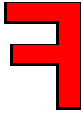
"That leaves me to flip my F from top to bottom," said Ali.
So then Ali's looked like this:

"Look, they are all different. I wonder if all the letters are like that. Which ones shall we try?"
Katie had spelt out Miss Chan's name with four of the letters:

"Let's try with those," suggested George. So they did.
What did they find out?
"What happens if you do a half turn followed by a sideways flip?" wondered Ali. "Do you think any of the letters in the box get back to the same as they were to begin with?"

They did find some which did just that. Which letters are they?
Do these letters also go back to the same if you do a half turn followed by a flip from top to bottom?
Getting Started
Cut out some letters and try for yourself. A mirror could be used.
Student Solutions
Sapna who goes to Sacred Heart School, looked at what happens to the letters of the alphabet when they are turned through a half turn, followed by a sideways flip. She drew out the letters one at a time and here are the ones that stay the same:
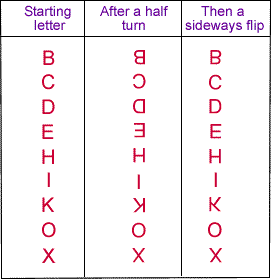
Of course, it will depend slightly on how you write the letters, but well done Sapna! Sam from Bispham Drive Junior School agreed with this list and explains:
These letters all worked because they have a horizontal line of symmetry. When doing a half turn they are upside down and backwards and flipping them over makes them right.
Can anyone answer the rest of the question? Do these letters stay the same with a half turn followed by a flip from top to bottom?
Teachers' Resources
Using NRICH Tasks Richly describes ways in which teachers and learners can work with NRICH tasks in the classroom.
Why do this problem?
This problem uses the letters of the alphabet to study the effects of transformations such as rotations and reflections. It requires learners to visualise and predict outcomes. It could help learners to acquire and practise the language of both symmetry and transformations such as vertical and horizontal reflections, and turning through $180^o$.
Key questions
Possible extension
Learners could systematically go through the letters of the whole alphabet.
Possible support
Suggest using a mirror or cutting out some letters and trying them.