

What's Left?

 2 out of 3
Use this grid to shade the numbers in the way described. Which numbers do you have left? Do you know what they are called?
Problem
Here is a grid showing the numbers $1-20$:
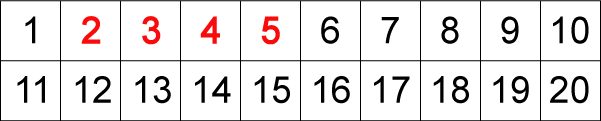
Start with the first red number, $2$. Now, look along the top row of the grid to the next number, $3$.
Can you share $3$ exactly between $2$?
If the answer is yes then shade in the $3$ box. If the answer is no, leave it.
Now take the next number, $4$. Can you share $4$ exactly between $2$?
Again, if you can, shade the box with $4$ in it. Carry on doing the same with all the numbers.
Now do the same with the next red number, $3$. Look along the row for the next number, $4$ and shade all the numbers that will share exactly between $3$.
Now try with $4$ and with $5$.
Which numbers do you have left?
Getting Started
You could start by making the table to use, then colouring in the numbers counting in $2$s omitting $2$ itself.
Student Solutions
Alistair from Histon and Impington Infants School says:
When I coloured all of the numbers that could be shared by 2, the even ones were coloured and the odd numbers were left. Then I coloured all the numbers that could be shared by 3. When I tried the numbers that could be shared by 4, there were no new ones because they were even. When I tried the numbers that could be shared by 5, I found they were already coloured.
Alistair sent us a diagram of his results:

Sim who lives in Singapore explains that the (black) numbers left are 7, 11, 13, 17, and 19, and that they are called prime numbers. Well done.
Sim also points out that 2, 3 and 5 are prime numbers too. I wonder whether anyone can notice something different about 2, the lowest prime number, compared with the others?
Teachers' Resources
Using NRICH Tasks Richly describes ways in which teachers and learners can work with NRICH tasks in the classroom.
Why do this problem?
This problem will help young learners to come to some understanding of factors and multiples leading to a first introduction to the idea of prime numbers. They will need to look at multiples of $2$, $3$ and $5$ up to $20$. For some children just making the table to use will be a useful exercise.
Key questions
Possible extension
Learners could make a grid which goes up to $40$ or even $100$ adding $6$ and $7$ to the "red" numbers.
Possible support
Suggest starting by making the table to use. Then colour in the numbers counting in $2$s omitting $2$ itself.