Four Triangles Puzzle
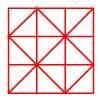
Cut four triangles from a square as shown in the picture. How many different shapes can you make by fitting the four triangles back together?
Players take it in turns to choose a dot on the grid. The winner is the first to have four dots that can be joined to form a square.
Zias have 3 legs and Zepts have 7 legs. If there were 52 legs, how many of each were there?
Use the lines on this figure to show how the square can be divided into 2 halves, 3 thirds, 6 sixths and 9 ninths.
How many different triangles can you make on a circular pegboard that has nine pegs?
What happens when you round these decimals to the nearest whole number?
Players take it in turns to choose a dot on the grid. The winner is the first to have four dots that can be joined to form a parallelogram.
Here is an interesting property about two sets of digits. Can you work out what the digits might be?
Roll three dice, then add two numbers and take away the other. What answers could you get?
Amy has a box of domino pieces. Which of her domino pieces are missing?
Sally and Ben were drawing shapes in chalk on the school playground. Can you work out what shapes each of them drew using the clues?
This challenge is a game for two players. Choose two of the numbers to multiply or divide, then mark your answer on the number line. Can you get four in a row?
Can you dissect an equilateral triangle into 6 smaller ones? What number of smaller equilateral triangles is it NOT possible to dissect a larger equilateral triangle into?
How many symmetric designs can you make on this grid? Can you find them all?
Play this game and see if you can figure out the computer's chosen number.
What can you discover about adding and subtracting sets of consecutive numbers?
This task develops spatial reasoning skills. By framing and asking questions a member of the team has to find out what mathematical object they have chosen.
Five children are taking part in a climbing competition with three parts, where their score for each part will be multiplied together. Can you see how the leaderboard will change depending on what happens in the final climb of the competition?
The sum of the numbers inside an envelope is written on the outside. What could the numbers be?
I'm thinking of a number. My number is both a multiple of 5 and a multiple of 6. What could my number be?
On the graph there are 28 marked points. These points all mark the vertices (corners) of eight hidden squares. Can you find the eight hidden squares?