Break It Up!
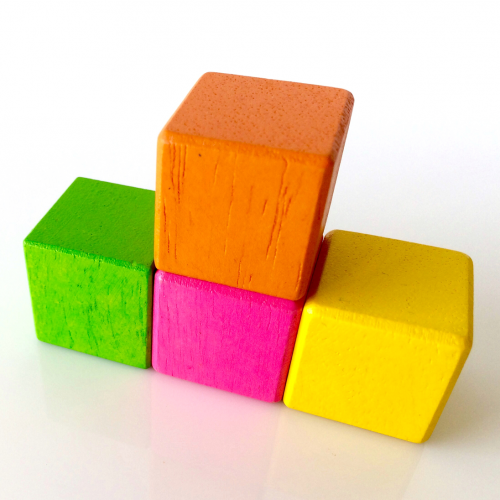
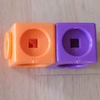
In how many different ways can you break up a stick of seven interlocking cubes? Now try with a stick of eight cubes and a stick of six cubes. What do you notice?

This is part of our collection of favourite rich tasks arranged by topic.
If you are a teacher, you can find the whole collection on our Primary Curriculum teacher page.
Alternatively, if you are a student, you'll find the same problems on our Primary Curriculum student page.
In how many different ways can you break up a stick of seven interlocking cubes? Now try with a stick of eight cubes and a stick of six cubes. What do you notice?

We can arrange dots in a similar way to the 5 on a dice and they usually sit quite well into a rectangular shape. How many altogether in this 3 by 5? What happens for other sizes?
Amy's mum gave her £2.50 to spend. She bought four times as many pens as pencils and was given 40p change. How many of each did she buy?
Can you replace the letters with numbers? Is there only one solution in each case?
One block is needed to make an up-and-down staircase, with one step up and one step down. How many blocks would be needed to build an up-and-down staircase with 5 steps up and 5 steps down?
These sixteen children are standing in four lines of four, one behind the other. They are each holding a card with a number on it. Can you work out the missing numbers?
These eleven shapes each stand for a different number. Can you use the number sentences to work out what they are?
The value of the circle changes in each of the following problems. Can you discover its value in each problem?
There are lots of different methods to find out what the shapes are worth - how many can you find?
Nearly all of us have made table patterns on hundred squares, that is 10 by 10 grids. This problem looks at the patterns on differently sized square grids.
Can you find a way of counting the spheres in these arrangements?
In this 100 square, look at the green square which contains the numbers 2, 3, 12 and 13. What is the sum of the numbers that are diagonally opposite each other? What do you notice?
How many solutions can you find to this sum? Each of the different letters stands for a different number.