

Alphabet Blocks

 1 out of 3
These alphabet bricks are painted in a special way. A is on one brick, B on two bricks, and so on. How many bricks will be painted by the time they have got to other letters of the alphabet?
Problem
A group of children painted letters of the alphabet on some cube bricks. They did it in a special way. They painted A on one brick, B on two bricks, C on three bricks, and so on.
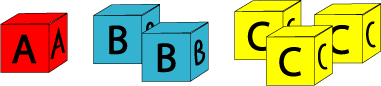
How many bricks had they painted by the time they had done the Cs?
How many bricks had they painted by the time they had done the Ds?
How many bricks had they painted by the time they had done the Es? And the Fs?
And the Gs?
And the Hs?
And the Is?
And the Js?
...
...?
Can you see why these totals are called triangle numbers?
Getting Started
What is the next letter of the alphabet?
How many bricks are needed for it?
How many bricks will that be altogether?
Student Solutions
Thomas from Beechwood Park School didn't stop at the blocks with J on them:
C=6
D=10
E=15
F=21
G=28
H=36
I=45
J=55
K=66
L=78
M=91
N=105
O=120
P=136
Q=153
R=171
S=190
T=210
U=231
V=253
W=276
X=300
Y=325
Z=351
Chloe and Georgia from Moorgate CP School, and Matt from St Andrew's School also calculated carefully.
Class 5 from Spring Grove Primary School in Hounslow told us:
These numbers are called triangle numbers because you would be able to arrange the number of blocks into a triangle formation. It would also work if they were counters as well.
That's right! Thank you.
Teachers' Resources
Using NRICH Tasks Richly describes ways in which teachers and learners can work with NRICH tasks in the classroom.
Why do this problem?
This problem is an interesting way of practising addition and can be used to introduce children to the triangle numbers. It can also provide a context in which children can make mathematical predictions and justifications.
Possible approach
Key questions
Possible extension
Possible support
