

The Third Dimension
 3 out of 3
Here are four cubes joined together. How many other arrangements of four cubes can you find? Can you draw them on dotty paper?
Problem
The Third Dimension printable sheet
Here are four cubes joined together:
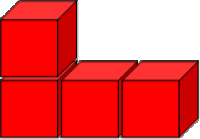
We can draw this arrangement of cubes on dotty paper (isometric paper) which gives us a way of drawing 3D objects more easily:
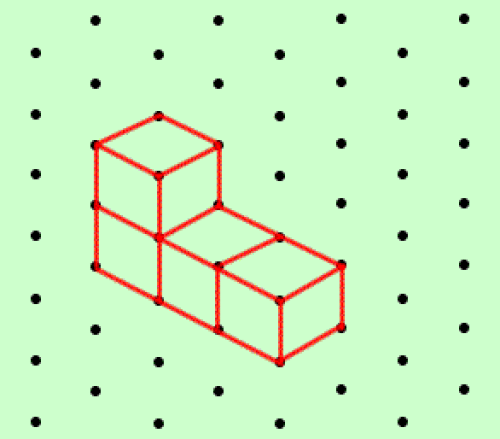
How many other arrangements of four cubes can you find?
Can you draw them on dotty paper? It's more difficult than it looks!
If you don't have any isometric paper, you can find some on our printable resources page, or you could use the interactivity below to draw your arrangements.
Getting Started
Use multilink cubes to make the arrangements. Keep each one so you can make sure they're all different.
When you have drawn your arrangements on dotty paper, try giving them to a friend. He or she can make the shapes as a check to see whether you've drawn them correctly.
Student Solutions
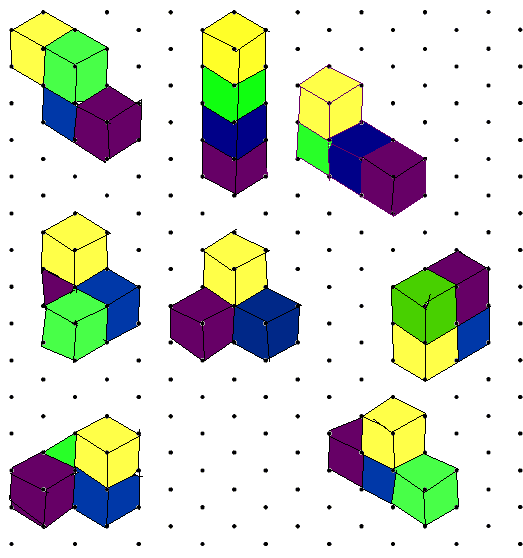
| Lots of you sent us excellent solutions for The Third Dimension. Chris and Michael from Moorfield Junior School, and Lily and Ruth from Brecknock Primary School in Camden managed to find eight arrangements altogether, including the one which we drew in the question. Lily explains how she systematically looked for them all: |
|
| Here is Ruth's drawing which shows these arrangements very clearly: |
Image
|
Ciara (from Bristol) explained her strategy:
First I built a tower with multilink where all four blocks were in a row. I called this 'The Tower'. Then I kept three in a row and moved one block into other possible positions. I gave them both names and this helped me with spotting if I'd done any repeats.
When I'd found all of these, I tried versions where there were no more than two blocks in a row. The names were really useful especially with the 'Staircases' as I realised there were two different ways of building the staircase.
In total I found 8 different possibilities for arranging four cubes.

Thank you for these good solutions. Well done !
Teachers' Resources
Using NRICH Tasks Richly describes ways in which teachers and learners can work with NRICH tasks in the classroom.
Why do this problem?
This problem helps learners to relate 3D solids to drawings of them. It requires a systematic approach.
Possible approach
You might like to begin by drawing a shape on isometric dotty paper on your interactive whiteboard which uses, for example, three cubes joined together. Working in pairs, ask children to create the shape for themselves out of interlocking cubes. Ask one child in each pair to draw another shape on isometric paper and for their partner to make it, then swap over. You could repeat this as necessary, depending on how much experience your class has of drawing in this way.
Introduce the problem itself by making the arrangement of four cubes shown in the picture. Leave pairs to try to make other arrangements for a while without saying much more at this stage, then bring the whole group together to discuss some issues. How are they checking that each shape they make is different from the shape/s they have already made? Has anyone got a good system for making the shapes so that they are sure they'll be able to find them all? Draw attention to those who have developed a clear approach, for example by having three cubes the same and looking for all the positions that the fourth cube could go etc. Having talked together in this way, children should feel confident enough to find all the different arrangements.
Their models and drawings would make an interesting display, particularly if some pairs were encouraged to describe in words how they went about finding all the possibilities.
Key questions
Is this arrangement different from this one? How do you know?
How will you know when you have found all the different arrangements?
Possible extension
Children could go on to make all the arrangements of five cubes - this is much more challenging and requires a very organised approach. Encourage them to use the four-cube arrangements as a basis for this extension.
Possible support
If some learners are struggling with drawing the models, provide enough cubes for them to be able to keep each one as they make it.
Some pupils might find it easier to try Building Blocks before starting this activity.