

Areas From Vectors
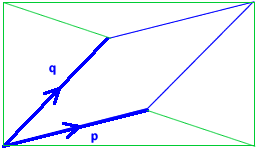
Use the applet to explore the area of a parallelogram and how it relates to vectors.
Problem
Move the blue points below to change the vectors that define the parallelogram.
See how the area changes.
Explore how the area of the parallelogram changes as you change the vectors.
If you would like some ideas of interesting questions to explore, take a look below.
Is there a formula for the area of a parallelogram if I know the two vectors?
Why does the formula work?
What is the formula in the special case when the parallelogram is a square?
What is special about the areas of the rhombuses you can make?
Student Solutions
Tony computed the answers for some particular cases.
$$a d-b c\ \text{ (or } bc-ad\text{ if } bc>ad)$$
Here's one way to work that out.
$$a b+b c+a d+c d-a b-b c-b c-c d=a d-b c$$
Yingtong Yan solved the problem differently, using stage 5 mathematics.
If we let $\mathbf{p}(x_1, y_1)$ and $\mathbf{q}(x_2, y_2)$ be our two vectors, then the cosinus of the angle between them is
$$\cos<\mathbf{p},\mathbf{q}>=\frac{\mathbf{p} \cdot \mathbf{q}}{|\mathbf{p}|\times |\mathbf{q}|}.$$
Therefore, $$\cos^2<\mathbf{p},\mathbf{q}>=\frac{(\mathbf{p} \cdot \mathbf{q})^2}{(|\mathbf{p}|\times |\mathbf{q}|)^2}$$
and, since $\sin^2<\mathbf{p},\mathbf{q}>+\cos^2<\mathbf{p},\mathbf{q}>=1$,
$$\sin^2<\mathbf{p},\mathbf{q}>=1 - \frac{(\mathbf{p} \cdot \mathbf{q})^2}{(|\mathbf{p}|\times |\mathbf{q}|)^2}= \frac{(|\mathbf{p}|\times |\mathbf{q}|)^2-(\mathbf{p} \cdot \mathbf{q})^2}{(|\mathbf{p}|\times |\mathbf{q}|)^2}.$$
Moreover, since the angle between $\mathbf{p}$ and $\mathbf{q}$ is smaller then $180^\circ$, then $\sin<\mathbf{p},\mathbf{q}>$ is greater then 0, and, hence, $\sin<\mathbf{p},\mathbf{q}> = \sqrt{\frac{(|\mathbf{p}|\times |\mathbf{q}|)^2-(\mathbf{p}\cdot\mathbf{q})^2}{(|\mathbf{p}|\times |\mathbf{q}|)^2} }$.
Using the fact that the parallelogram is made out of two congruent triangles of area $\frac{1}{2}\times\sin<\mathbf{p},\mathbf{q}>\times |\mathbf{p}|\times |\mathbf{q}|$, the area of the parallelogram is
$$\begin{aligned}
A_{\text{parallelogram}} &= 2\times \frac{1}{2}\times\sin<\mathbf{p},\mathbf{q}>\times |\mathbf{p}|\times |\mathbf{q}| \\
&= \sqrt{\frac{(|\mathbf{p}|\times |\mathbf{q}|)^2-(\mathbf{p}\cdot\mathbf{q})^2}{(|\mathbf{p}|\times |\mathbf{q}|)^2} }\times |\mathbf{p|}\times |\mathbf{q}| \\
&= \sqrt{ (|\mathbf{p}|\times |\mathbf{q}|)^2-(\mathbf{p}\cdot\mathbf{q})^2} \\
&= \sqrt{(x_1^2+y_1^2)\times (x_2^2+y_2^2) - (x_1x_2+y_1y_2)^2} \\
&=\sqrt{x_1^2y_2^2+x_2^2y_1^2-2x_1x_2y_1y_2} \\
&=|x_1y_2-x_2y_1|
\end{aligned}$$
Beth and Susie analyzed the special case when the parallelogram is a square.
If the parallelogram is a square then $|\mathbf{p}|=|\mathbf{q}|$ and the area is $|\mathbf{p}|^2$. Since $|\mathbf{p}|=\sqrt{a^2+b^2}$, the area is $\sqrt{a^2+b^2}^2=a^2+b^2$.
Well done to everyone who sent in a solution. Keep exploring!
Teachers' Resources
For ideas on how this problem and others from the Dotty Grids Collections can be used in the classroom, you may be interested to read this article.