Investigating Pascal's Triangle
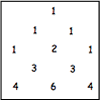
In this investigation, we look at Pascal's Triangle in a slightly different way - rotated and with the top line of ones taken off.
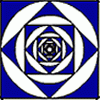
If you continue the pattern, can you predict what each of the following areas will be? Try to explain your prediction.
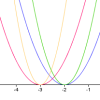
Explore what happens when you draw graphs of quadratic equations with coefficients based on a geometric sequence.
Can you correctly order the steps in the proof of the formula for the sum of the first n terms in a geometric sequence?
The interval 0 - 1 is marked into halves, quarters, eighths ... etc. Vertical lines are drawn at these points, heights depending on positions. What happens as this process goes on indefinitely?
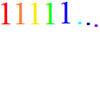
If a number N is expressed in binary by using only 'ones,' what can you say about its square (in binary)?
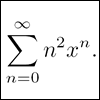
Generalise the sum of a GP by using derivatives to make the coefficients into powers of the natural numbers.
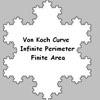
Make a poster using equilateral triangles with sides 27, 9, 3 and 1 units assembled as stage 3 of the Von Koch fractal. Investigate areas & lengths when you repeat a process infinitely often.