What's the Problem With Problem Solving?
Becoming a mathematical problem solver really is the point of doing mathematics, so this article offers ideas and strategies to ensure that every lesson can be a problem solving lesson.


Not all of us a bursting with creative game ideas, but there are several ways to go about creating a game that will assist even the busiest and most reluctant game designer.
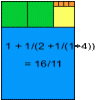
Can you work out how many apples there are in this fruit bowl if you know what fraction there are?
Have a look at what happens when you pull a reef knot and a granny knot tight. Which do you think is best for securing things together? Why?
Can you prove that a quadrilateral drawn inside a tetrahedron is a parallelogram?
Have a go at this game which involves throwing two dice and adding their totals. Where should you place your counters to be more likely to win?
Is it possible to rearrange the numbers 1,2......12 around a clock face in such a way that every two numbers in adjacent positions differ by any of 3, 4 or 5 hours?
We continue the discussion given in Euclid's Algorithm I, and here we shall discover when an equation of the form ax+by=c has no solutions, and when it has infinitely many solutions.