

Torn Shapes

 1 out of 3
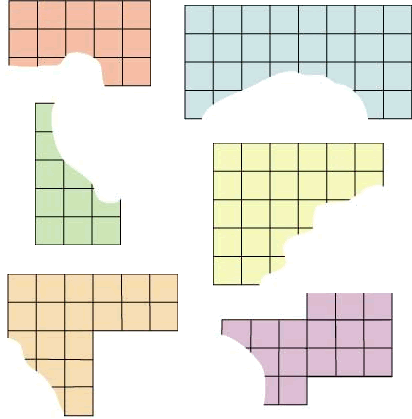
These rectangles have been torn. How many squares did each one have inside it before it was ripped?
Problem
Jason's class cut out rectangles and some shapes which were two rectangles joined together from one centimetre squared paper.
They then counted how many squares the shapes took up.
After this they tore a piece out of some of their shapes to make a puzzle for the other groups to do.
Can you work out how many squares there were in these shapes before the bit was torn out? The orange, blue, green and yellow shapes were rectangles. The bottom two shapes, which are pale orange and purple, were each two rectangles joined together.
Courtney's group tore too much off their grey rectangle!

What is the smallest number of squares it could have had?
What is the largest number of squares it could have had if it was not longer than the longest of the other shapes?
Getting Started
Can you draw in the rest of the shape?
You could try cutting similar shapes out of squared paper.
Student Solutions
Another well answered problem! Particularly clear solutions were sent in by James from St Mary's School, Sara-Louise from Perton Middle School and Rowena from Christ Church Infants. Sara-Louise said:
My method for this problem was to count the number of squares along one side, then times them by the number of squares along the other side.
For the rectangles that were made up of two shapes, I first split the single shape into two, timesed the number of squares along the sides of the shapes (separately), then added them together.
Rowena had a slightly different way of finding out the number of squares taken up by each shape. She wrote:
I am going to count the whole squares up and across, then draw the outline of the rectangle, and then draw the squares on to it that weren't there before. I will count the squares and put the total into a table.
Here's Rowena's table:
| Rectangle | Number of Squares |
| Orange | 3 down x 5 across = 15 |
| Blue | 4 down x 8 across = 32 |
| Green | 5 down x 3 across = 15 |
| Yellow | 5 down by 6 across = 30 |
| Pale orange | 21 |
| Purple | 18 |
For the final shape, James said:
Teachers' Resources
Using NRICH Tasks Richly describes ways in which teachers and learners can work with NRICH tasks in the classroom.
Why do this problem?
This problem is a good way to assess children's understanding of properties of rectangles. The problem is a nice lead into area, although this is not specifically mentioned in the wording. Torn Shapes is a challenge that encourages children to adopt a different technique for finding area rather than simply counting squares.
Possible approach
You could introduce these ideas by drawing a torn shape of your own, or cutting out a shape and then tearing it (perhaps part of a square or a triangle), and asking the children to decide how many small squares it takes up. This might involve you asking the group for suggestions as to how they might go about solving the problem, and probably modelling these for them.
After this you could show the group the actual problem on an interactive whiteboard or data projector. Then they could work on it in pairs with the shapes from this sheet or on screen with access to squared paper. It is important to allow plenty of time for children to share their thinking and explanations with their partners and the rest of the group. Some children might want to count each square individually, but that is difficult with this problem. Others might count a row or column and use their knowledge of multiples. It is likely that they will spend some time discussing how best to approach this problem before reaching that conclusion.
As a plenary activity, you could have a torn piece of squared paper which is ambiguous in terms of the original shape it came from and use this to discuss the possible numbers of squares it contains. There is no reason why you should not make your own torn shapes from squared paper using the activity as an idea rather than a problem to be solved.
Key questions
How many squares are there in a row that is complete?
How many rows are there altogether whether they are complete or not?
Possible extension
You could change the last part of the question so that, rather than it being no longer than any of the other shapes, the final shape has no more than 100 squares. Can learners find all the possible solutions? Challenge them to articulate the pattern in the answers.
Possible support
Children would benefit from trying Wallpaper first.