

The Magic Number and the Hepta-Tree

 2 out of 3
Find the exact difference between the largest ball and the smallest ball on the Hepta Tree and then use this to work out the MAGIC NUMBER!
Problem
The Mathemagician needs to break a dreadful spell! Help him to find the magic number that will do the trick!
Here is the hepta-tree hung with silver balls.
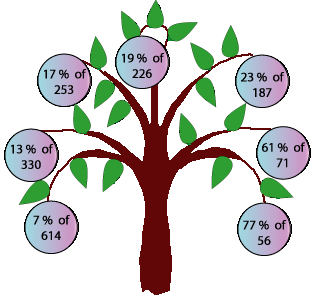
Do you think the balls will have similar values?
Try estimating the amount on each ball.
In order to break the spell, firstly find the exact difference between the largest ball and the smallest ball.
Multiply your result by $244$.
Round this to a whole number and that gives us the MAGIC NUMBER!
Give this number to the Mathemagician and the terrible spell will be broken for ever!
Getting Started
It might be useful to round the percentages up or down to estimate the value of the balls.
You could think of a percentage as a fraction or decimal.
Student Solutions
We received many solutions to this problem, although not so many of you explained exactly how you arrived at your answer. Remember, we're always on the look out for your reasoning too.
Elijah let us know his estimates of the number on each ball:
$7\%$ of $614$ is ~$50$
$13\%$ of $330$ is ~$41$
$17\%$ of $253$ is ~$40$
$19\%$ of $226$ is ~$40$
$23\%$ of $187$ is ~$43$
$61\%$ of $71$ is ~$42$
$77\%$ of $56$ is ~$36$
You didn't say how you made these estimations, Elijah. It would be interesting to know ...
'Team Sean', which consisted of Sean, Liz, Briana, Alysha, Amy, Amelia, Chris, Ben, Charlie, Kaden, Matt, Josh, Kate, Stacey, Roy, Mitchell, Dylan, Ed, Emma and Grace gave a detailed explanation of their method for finding the magic number:
Step $1$ -
We turned the percentages into fractions and divided the top by the bottom, then we multiplied that answer by the number in the ball. (Alysha)
Example - (Briana) $\frac{23}{100} \times 187 = 43.01$
Step $2$ -
We found the biggest and smallest answers and subtracted the small one from the bigger one. (Dylan)
(Liz) $43.31-42.9 = 0.41$
Step $3$ -
You multiply the answer by $244$ (Josh)
(Sean) $0.41 \times 244 = 100.04$
Step $4$ -
On a number line, from $100.04$, you need $96$ more hundredths to get to $101$ but you only need to go back $4$ hundredths to get to $100$.
Therefore the magic number is $100$ because $100.04$ rounds down to $100$. (Alysha, Charlie and Matt)
We also received good solutions from Adam and Chris who both go to Orchard Primary School, and Callum and Eddie from Stourport Primary. Lucy used a spreadsheet to calculate the percentages rather than a calculator, which works equally well. Well done all of you!
Teachers' Resources
Using NRICH Tasks Richly describes ways in which teachers and learners can work with NRICH tasks in the classroom.
Why do this problem?
This problem gives work on percentages in an interesting and challenging way. It also gives you an opportunity to discuss different ways of estimating and therefore shows learners how expressions which look very different can give very close answers.
Possible approach
Key questions
Possible extension
Learners could create more percentages like the ones on the hepta-tree which look different but have very close answers. These could range like the ones in the problem or approximate to another number. It would be interesting to talk to children about how they were coming up with the percentages.
Possible support
Using this sheet will help children organise their calculations and it may be appropriate for some to use a calculator.