

Four-Triangle Arrangements
 3 out of 3
How many different shapes can you make by putting four right- angled isosceles triangles together?
Problem
Well, equilateral triangles are great fun to play around with (try Triangle Animals if you haven't already!) but let's not forget the right-angled triangle - particularly the kind that comes from cutting a square in half through a diagonal.
We could take 4 of these and have something like this:

So we can make some rules about how we can re-arrange these four triangles.
Here's a usual rule - EACH SIDE MUST MATCH UP TO A SIDE THAT'S JUST THE SAME LENGTH AND THEY MUST HAVE THEIR VERTICES TOUCHING.


The four arrangments above would obey the rule. But the next two would NOT obey the rule. Can you say a reason why?


So, using plastic, paper, card or other triangles, what arrangements can you make with four right-angled isosceles triangles like the ones at the start?
You will have to decide about allowing "flipping over" or not.
Like in so many investigations it's good after a while to change a bit of the rule and start again.
So let's say that the four must be joined together BUT you can have them joining with one vertex and all OR part of a side touching.
For example the red and orange ones we've already seen above are now allowed:
Others might be:



Now it's your turn.
What arrangements can you find with these new rules?
Getting Started
Starting with good squares and getting them cut in half from corner to corner as best as you can is really helpful. If necessary get someone to help.
You can record these by simply drawing around them, but find whatever suits you best. A digital camera may be good - or even a computer drawing program.
How will you know when you have got them all?
Student Solutions
These are the ones we found for the first rule.


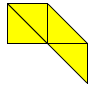

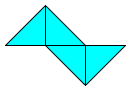

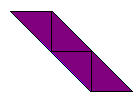
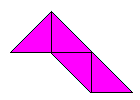
These are some extra ones we found for the second:



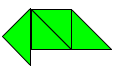
Again we worked in a system just moving one triangle and keeping the other three fixed. So there are many, many more to find for this second rule.
Teachers' Resources
Using NRICH Tasks Richly describes ways in which teachers and learners can work with NRICH tasks in the classroom.
Why do this problem?
The main reason for using this problem is to encourage pupils to develop a system for finding all the possible arrangements. This is something that they might find difficult. So before tackling this problem, you may like to introduce your group to Triangle Animals.
Possible approach
This is an ideal activity for pupils to work on in pairs and you can learn a lot about their mathematical understanding from listening to them talk. After allowing them time to have a go at this problem, it might be a good idea to draw the whole class together to ask how they are going to be sure that they've found all the different arrangements. At this point, some might have tried to implement a system of their own. If they have, you could use this as a model for everyone, but it might be necessary for you to initiate such a system. For example, you could start by holding three of the triangles still and then move the fourth to different positions. At this stage, you might also want to address the issue of what arrangements are the same and what are different. It might be easier to come to an agreement on this by not allowing "flips", for example.