

Rectangular Pyramids

 1 out of 3
Is the sum of the squares of two opposite sloping edges of a rectangular based pyramid equal to the sum of the squares of the other two sloping edges?
Problem
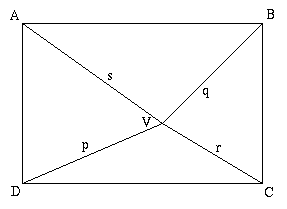
Is it true that $p^2+q^2=s^2+r^2$ when:
| Image
|
Getting Started
Think about right-angled triangles.
Student Solutions
A proof of this result came from students from the Key Stage 3 Maths Club at Strabane Grammar School, Northern Ireland and the following one from Joel, ACS (Barker) Singapore:
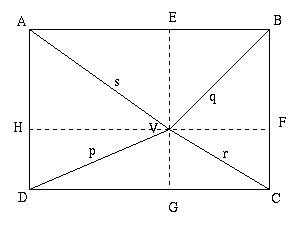
(a) In the diagram given (in 2 dimensions) p 2 + q 2 = r 2 + s 2
Proof
Draw 2 lines through V parallel to the edges of the rectangle, dividing the figure into four pairs of right-angled triangles. Label the point on AB as E, on BC as F, on CD as G and on DA as H. By Pythagoras theorem:
| p 2 = DG 2 +DH 2 |
| q 2 = BE 2 + BF 2 |
| r 2 = CF 2 + CG 2 |
| s 2 = AE 2 + AH 2 |
Since DG=AE, CG=BE, AH=BF and CF=DH,
p 2 + q 2 = AE 2 + CF 2 + CG 2 + AH 2 = r 2 + s 2
(b) If the diagram represents a pyramid on a rectangular base where p, q, r and s are the lengths of the sloping edges then the result p 2 + q 2 = r 2 + s 2 still holds true.
Proof
Let V 1 be the foot of the perpendicular from V to the base ABCD of the pyramid and let h be the height of the pyramid so that VV 1 = h and let V 1 A = s 1 , V 1 B = q 1 , V 1 C = r 1 , and V 1 D= p 1 .
By Pythagoras theorem we have: p 1 2 + h 2 = p 2 , q 1 2 + h 2 = q 2 , r 1 2 + h 2 = r 2 and s 1 2 + h 2 = s 2 .
Using the result already proved in 2dimensions, that is
p 1 2 + q 1 2 = r 1 2 + s 1 2 ,
we get p 1 2 + q 1 2 + 2h 2 = r 1 2 + s 1 2 + 2h 2
so p 2 + q 2 = r 2 + s 2 .
Teachers' Resources
Using NRICH Tasks Richly describes ways in which teachers and learners can work with NRICH tasks in the classroom.
Why do this problem?
It provides experience of generalising a result from 2 dimensions to an equivalent result in 3 dimensions. This problem asks the question for them but learners should be encouraged to ask themselves "What if..." and always to think about possible generalisations.
Key questions
What comes to mind when a problem involves squares of distances?
If we are looking for Pythagoras theorem where are the right angles triangles?
Possible extension
The problem Pythagoras for a Tetrahedron.