

Big Powers

Three people chose this as a favourite problem. It is the sort of problem that needs thinking time - but once the connection is made it gives access to many similar ideas.
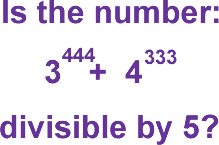
Problem
Getting Started
What determines whether a number is divisible by $5$ or not?
Find: $3^{1}, 3^{2}, 3^{3}, 3^{4}, 3^{5}, 3^{6}, 3^{7}, 3^{8}, 3^{9} \ldots$
What do you notice?
Find: $4^{1}, 4^{2}, 4^{3}, 4^{4}, 4^{5}, 4^{6}, 4^{7}, 4^{8}, 4^{9} \ldots$
What do you notice?
Student Solutions
In the main, successful solvers of this problem went about it in one of two ways.
One way was to 'break it down' and study the ones/units digit for a set of powers. This is what Samantha and Zoe of Maidstone Girls' Grammar School and Angela from Hethersett High in Norfolk did.
Another way was to look at some remainders when dividing by $5$. This is what Avishek, James, Martin, Thomas, Kintel and Marcus from Simon Langton Boys' School did.
This is Angela's solution:
You have to think about how you distinguish numbers that are divisible by five, they are whole numbers that have a ones/units digit of five or zero. So you know that for this number to divide by five it has to end in a five or zero and it is on the basis of this knowledge that we can work out this problem.
There is a pattern in the ones/units digits for powers of $3$:
$3$
$3\times 3=9$
$3\times 3\times 3=27$
$3\times 3\times 3\times 3=81$
$3\times 3\times 3\times 3\times 3=243$
$3\times 3\times3\times 3\times 3\times 3=729$
From this pattern we know that $3^{444}$ is going to be a whole number ending in a $1$ because $444$ is divisible by $4$.
$4^{333}$ works in much the same way. The ones/units digit for powers of $4$ are alternately $4$ and $6$. Using these results we see that $4^{333}$ will be a whole number ending in a $4$.
So now combine all the information we have so far which is:
$3^{444}$ will end in a $1$
$4^{333}$ will end in a $4$
and $1+4=5$.
So $3^{444}+4^{333}$ will end in a $5$ and so it is divisible by $5$.
There is an assumption here that these patterns in the ones/units digits continue to hold for ALL positive powers of $3$ and $4$ and you might like to take up the challenge of proving this.
$$3^{444} + 4^{333} = (3^4)^{111} + (4^3)^{111} = a^{111} + b^{111}$$ where we define $a = 3^4$ and $b=4^3$.
Now, any expression of the form: $a^n + b^n$, has $(a+b)$ as a factor, when $n = 1, 3, 5 \dots$
That is, we can write $$a^n + b^n = (a+b )( \dots)$$ We know that: $$ a + b = 3^4 + 4^3 = 81 + 64 =145,$$ and since $145$ is divisible by $5$, $3^{444} + 4^{333}$ must be divisible by $5$ too.
Teachers' Resources
At first glance, a challenging problem; but no algebra is required to justify the solution.
Students who meet this problem for the first time may need a significant amount of support in structuring a solution so it is useful to be able to find similar tasks to which they may apply their new-found understanding.
It is important to be able to justify any pattern. How can you be sure it continues?