

Guess the Houses

 1 out of 3
This task depends on learners sharing reasoning, listening to opinions, reflecting and pulling ideas together.
Problem
This is one of a series of problems designed to develop learners' team working skills. Other tasks in the series can be found by going to this article.
What are you aiming to do?
For the task:
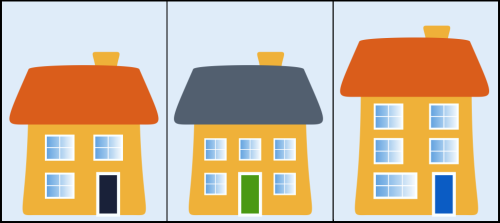
The team has to find the rule on the Ruler's card, using the minimum number of tests. A test is asking whether a particular house obeys the rule.
As a team:
- finding out what others think
- giving reasons for ideas
- being concise
- reflecting on what has been said
- allowing everyone to contribute.
Getting started
- the set of rules cards - only use the cards with a black border to start with.
- a piece of coloured paper (the Box)
- the set of house cards.
Tackling the problem
- The team has the set of house cards.
- The Ruler selects a rule card from the pack and keeps it hidden from the rest of the team.
- Before deciding on a house to present to the Ruler for testing - the team must discuss and agree as a team why they think it would make a good test case.
- If the house obeys the rule then the Ruler puts it in the Box, if it does not obey the rule it is placed outside the Box.
- If someone thinks they know the rule, they must share their reasoning with the rest of the team, who discuss and check their reasoning before deciding if it is a suitable conjecture to put forward.
- The Ruler then reveals the rule.
- If the team is right the task can start again with a different Ruler. If they are wrong they discuss where their error in reasoning may have been before moving on, or whether two rules could give the same set of houses in the "box".
Team and Ruler Guidelines
- No one should choose a card for testing without the agreement of the rest of the team.
- You are trying to find the rule by testing the minimum number of houses.
- The Ruler can only put a chosen card in the Box or outside it.
- The Ruler can only speak to state whether the rule the team have decided on is correct or not.
Observer Guidelines
- Make a note of how often each member of the team contributes to the discussion.
- Check that the Ruler only tests a house that has been chosen by the agreement of the whole team.
- Look for occasions when someone asks someone else's opinion.
- Look for occasions when someone listens and responds to someone else's ideas.
Alternative version
We have written a version of this task which is suitable for one child and an adult playing together at home.
Student Solutions
As this activity is for groups to work on and there are all sorts of possible outcomes, we haven't received any solutions.
However, if you have a go at it, we'd love to hear how you got on as a group. Did you work well together?
Teachers' Resources
Using NRICH Tasks Richly describes ways in which teachers and learners can work with NRICH tasks in the classroom.
Why do this problem?
This task encourages learners to ensure all members of the team participate, share their reasoning, listen to each other's opinions, and reflect on the outcome. This is one of a series of problems designed to develop learners' team-working skills. Other tasks in the series can be found by going to this article.
Possible approach
To start with, use the rule cards with a black border in this document: word, pdf.
When teams have finished working on the task it is important that they spend time discussing in groups, and then as a whole class, how well they worked as a team. They can consider what they have learned from the experience and what they would do differently next time, particularly in terms of how to listen to each other and ensure that all members of the team participate. Your own observations, as well as those of observers, might inform the discussions.
Why not let us know how the children have got on with their group-working skills by clicking on the 'Submit a solution' link?
Key questions
- Was there a choice of house to test that was particularly useful? Why?
- Were there any ideas that proved really helpful?
- How well did you listen to others in your group?
- How did you ensure that everyone had a chance to contribute?
Possible extension