

Centred

 1 out of 3
Weekly Problem 13 - 2012
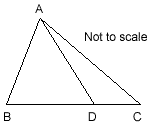
The diagram shows contains some equal lengths. Can you work out one of the angles?
Problem
In the triangle $ABC$, $AD = BD = CD$. What is the size of angle $BAC$?
If you liked this problem, here is an NRICH task which challenges you to use similar mathematical ideas.
Student Solutions
$\angle BAC = 90^{\circ}$
$A$, $B$ and $C$ are all equidistant from $D$ and therefore lie on a circle whose centre is $D$. $BC$ is a diameter of the circle and $\angle BAC$ is therefore the angle subtended by a diameter at a point on the circumference (the angle in the semicircle).
Alternatively, suppose $\angle ACD = x$. Then, $\angle BAC = x$ also, as $DAC$ is isosceles. This means $\angle CDA = 180 - 2x$ by angles in a triangle, so $\angle ABC = 2x$. Then, as $ADB$ is also isosceles, $\angle BAD = \angle DBA = \frac{1}{2}(180-2x) = 90-x$. Therefore, $\angle BAC = \angle BAD + \angle DAC = 90-x+x=90^\circ$