

Castles in the Middle

 2 out of 3
This task depends on groups working collaboratively, discussing and reasoning to agree a final product.
Problem
This is one of a series of problems designed to develop learners' team working skills. Other tasks in the series can be found by going to this article.
What are you aiming to do?
For the task:
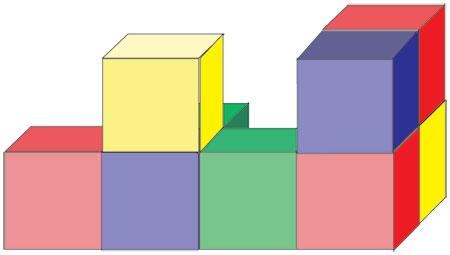
The team has to recreate the 3-D solid or "castle" (created by the designer) by asking as few questions as possible.
As a team:
- Listening and finding out what others think
- Giving reasons for ideas
- Pulling ideas together
- Finding out whether the group is ready to make a decision.
Getting started
Tackling the problem
Task Rules:
You are trying to recreate the castle using as few questions as possible.
- You must agree any question before asking the designer.
- The team can only ask questions of the type listed in the rules.
- The team must take turns in asking questions.
- The designer can only answer "Yes", "No" or give a number.
Designer guidelines:
- You do not have to use all the cubes.
- The cubes should be arranged so that each cube has at least one full face touching another cube and all faces must fit together exactly (no overlaps).
- You only answer a question if the team has discussed and agreed it first.
- You only answer questions of the agreed type.
- You can only say "Yes" or "No", or give a number as an answer.
Team question rules:
- the number of cubes,
- the number of cubes of each colour,
- the number of cubes in each row, column or layer,
- the number of cubes touching a given cube,
- the number of cubes of different colours touching a given cube,
- the colour of a cube in a particular position,
- the symmetry properties of the castle,
- any holes or gaps in the castle.
Observer Guidelines:
- identify the times when reasons for ideas are given by members of the team,
- check that everyone agrees before a question is asked,
- check that the questions fit those allowed in the rules,
- check that members of the team take it in turns to ask questions,
- count the number of questions the team ask.
Teachers' Resources
Using NRICH Tasks Richly describes ways in which teachers and learners can work with NRICH tasks in the classroom.
Why do this problem?
This task encourages the development of team-building skills such as sharing reasoning, allowing everyone to contribute and valuing those contributions, and coming to a consensus. This is one of a series of problems designed to develop learners' team-working skills. Other tasks in the series can be found by going to this article. In addition learners are expected to use precision in describing the arrangement of the cubes.
Possible approach
- all castles have at least one line of symmetry,
- all castles have at least two turrets.
Cards for each role:
- The rule cards for questioning can be found here: word, pdf.
- The role card for designers can be found here: word, pdf.
- The role card for observers can be found here: word, pdf.
Key questions
- What things did you hear someone else say that you found really helpful?
- How well did you listen to others in your group?
- How easy was it to come to an agreement about the questions to ask?
- Did everyone always agree and what did you do if you did not?
Possible extension
Possible support
- How many cubes are there?
- What colour is the cube to the left of the red cube?
- Is the cube on top of/below the red cube blue?
- Is there a cube behind/infront of the blue cube?