

Ruler
The interval 0 - 1 is marked into halves, quarters, eighths ... etc. Vertical lines are drawn at these points, heights depending on positions. What happens as this process goes on indefinitely?


Problem
Now consider the line $y=h$ where ${1\over 2^n} > h > {1\over 2^{n+1}}$ . How many of the vertical lines from $x=0$ to $x=1$ does it cut?
What happens to the heights of these lines as $n$ gets larger? What happens to the number of lines cut as $n$ gets larger?
Getting Started
Apart from the very start of the process, the number of lines cut for each subsequent set of vertical spikes is doubled so giving a geometric sequence.
Student Solutions
Andaleeb sent in this excellent solution.
The diagram shows some of the vertical lines drawn for values of x between 0 and 1 as described in the question. The lines are of height 1 unit at x = 0 and 1, of height ${1\over 2}$ units at $x= {1\over 2}$ , of height ${1\over 4}$ units at $x= {k\over 4}$ and ${1\over 8}$ units at $x= {k\over 8}$ and so on... up to ${1\over 2^5}$ at ${k\over 2^5}$ where $k$ is a positive integer.
| n | $0$ | $1$ | $2$ | $3$ | $4$ | $5$ | $6$ | $\dots$ | $n$ | $n+1$ |
| Height | $1$ | ${1\over 2}$ | ${1\over 4 }$ | ${1\over 8}$ | ${1\over 16}$ | ${1\over 32 }$ | ${1\over 64}$ | $\dots$ | ${1\over 2^n}$ | ${1\over 2^{n+1}}$ |
| Lines cut | $2$ | $1$ | $2$ | $4$ | $8$ | $16$ | $32$ | $\dots$ | $2^{n-1}$ | $ 2^n$ |
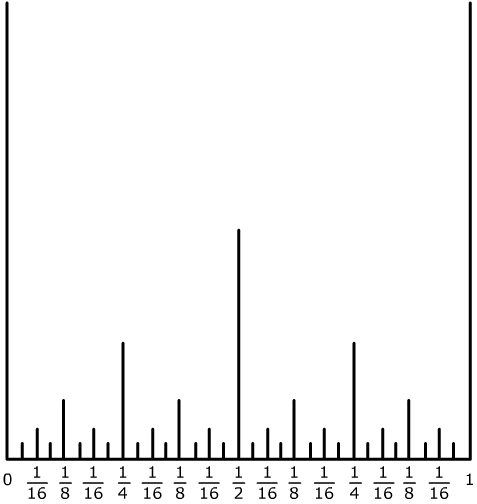
Thus if the height $h$ lies in ${1\over 2^n} > h> {1\over 2^{n+1}}$ then the number of lines cut is given by $$ 2 + 1 + 2 + 4 + 8 + ... + 2^{n-1} = 2 + {{2^n - 1} \over {2 - 1}} = 2^n + 1.$$ As $n$ tends to infinity the height of the lines tends to 0 and the number of lines cut tends to infinity.