

Numerically Equal

 2 out of 3
Can you draw a square in which the perimeter is numerically equal to the area?
Problem
Numerically Equal printable sheet
I want to draw a square in which the perimeter is numerically equal to the area.

Of course, the perimeter will be measured in units of length, for example, centimetres (cm) while the area will be measured in square units, for example, square centimetres (cm$^2$).
What size square will I need to draw?
What about drawing a rectangle that is twice as long as it is wide which still has a perimeter numerically equal to its area?
Can They Be Equal? offers a suitable extension to this problem.
Getting Started
You could try drawing squares on squared paper.
How will you know you don't miss out the square that works?
Student Solutions
The solutions that arrived on our desk for Numerically Equal all had the same answer, but slightly different ways of finding it. Jack of Tattingstone Primary School sketched the stages of his thinking.
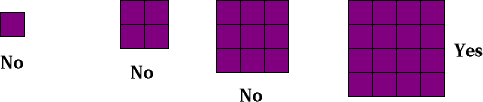
Chris used addition to help him with the perimeter calculation:
$4cm+4cm+4cm+4cm = 16cm$
Whereas, Sam of St Margaret's Primary School in Newcastle-under-Lyme, changed this to multiplication:
$4cm$ x $4$ (sides) $= 16cm$
Does this measurement of 4cm work for the area? According to Annice and Grace in Yarm Primary School, and Thomas it does! Backing them up with their answers were Jade and Marion both of Tattingstone Primary. Great explanations came from both girls.
Asher had the same idea as a Franco of Hazelwood School, London. Franco solved this "within a few minutes by thinking of square numbers and dividing them by 4". He hit upon a 4cm square as one possible answer but remains convinced it is not the only one and has gone to do further investigations on his own! Good for you Franco, let us know of any other solutions your investigations reveal.
There was a second challenge here, finding a rectangle that is twice as long as it is wide and that has an area and perimeter of 18 units. Daniel , Marion and Jade (all of Tattingstone School) had the same strategy that worked very well for each of them. Each drew a rectangle then drew the same size rectangle attached to it and calculated the area. Jack shows us a similar way to Marion and Jade's and how he can prove his answer.
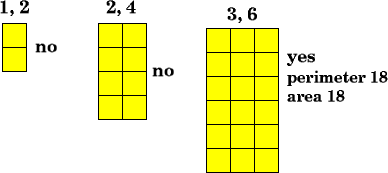
Christopher and James both explained in words and numbers rather than diagrams:
The perimeter will be $6+3+6+3$ which equals $18cm$.
The area is $6$ x $3$ which equals $18 cm^2$.
Teachers' Resources
Using NRICH Tasks Richly describes ways in which teachers and learners can work with NRICH tasks in the classroom.
Why do this problem?
This problem requires learners to consider area and perimeter at the same time and to know the difference between the two. It provides a good opportunity to talk about different ways of reaching a solution.
Possible approach
When introducing this problem it is necessary to emphasise that although the perimeter and the area will be 'numerically equal', that is, the same number, they are not the same measurement because the perimeter will be measured in units of length, such as centimetres (cm), while the area will be measured in square units, such as square centimetres (cm$^2$).
Once children have understood the task, they could work in pairs so that they are able to talk through their ideas with a partner. Having squared paper available would be a good idea, although not all learners will choose to use it.
It would be interesting and instructive to listen to the way that the various pairs are working on the problem because there are many possible approaches and in the plenary, you can draw this out. Give pairs time to explain how they reached an answer - for example, they might have drawn squares and calculated area/perimeter until they found one that works; they might have taken a purely numerical approach by looking at square numbers and dividing them by four. In either case, some pupils might notice patterns in the numbers obtained which helped them to know they were getting close. You could ask the class to comment about the advantages of each different way and you could then split them into small groups to produce posters about each method for display.
Key questions
What is the perimeter of this square? What is its area?
How will you know you haven't missed out the square that works?
Possible extension
The second half of the problem could be used as an extension and could be continued with a question such as: "What about a rectangle that is three times as long as it is wide?"
Possible support
Being able to draw squares on squared paper, and record the area and perimeter of each one, should help all pupils access this problem.