 Links to the NRICH website Home page

30 April (Primary), 1 May (Secondary)
Resources tagged with: Games
There are 61 NRICH Mathematical resources connected to Games, you may find related items under Physical and digital manipulatives.
Broad Topics > Physical and digital manipulatives > Games
Rhombus It
Players take it in turns to choose a dot on the grid. The winner is the first to have four dots that can be joined to form a rhombus.



Parallelogram It
Players take it in turns to choose a dot on the grid. The winner is the first to have four dots that can be joined to form a parallelogram.

Charlie's Delightful Machine
Here is a machine with four coloured lights. Can you develop a strategy to work out the rules controlling each light?

Diamond Collector
Collect as many diamonds as you can by drawing three straight lines.

Factors and Multiples Game
A game in which players take it in turns to choose a number. Can you block your opponent?
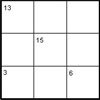
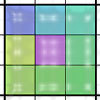
Diagonal Sums Sudoku
Solve this Sudoku puzzle whose clues are in the form of sums of the numbers which should appear in diagonal opposite cells.
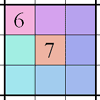
Diagonal Product Sudoku
Given the products of diagonally opposite cells - can you complete this Sudoku?

Fractions and Percentages Card Game
Can you find the pairs that represent the same amount of money?
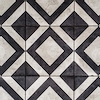
Square It
Players take it in turns to choose a dot on the grid. The winner is the first to have four dots that can be joined to form a square.
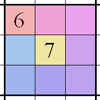
Wallpaper Sudoku
A Sudoku that uses transformations as supporting clues.

Games Related to Nim
This article for teachers describes several games, found on the site, all of which have a related structure that can be used to develop the skills of strategic planning.
Winning Lines
An article for teachers and pupils that encourages you to look at the mathematical properties of similar games.
Using Games in the Classroom
Gillian Hatch analyses what goes on when mathematical games are used as a pedagogic device.

Last Biscuit
Can you find a strategy that ensures you get to take the last biscuit in this game?

Sliding Puzzle
The aim of the game is to slide the green square from the top right hand corner to the bottom left hand corner in the least number of moves.
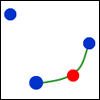
Sprouts Explained
This article invites you to get familiar with a strategic game called "sprouts". The game is simple enough for younger children to understand, and has also provided experienced mathematicians with significant food for thought.

Going First
This article shows how abstract thinking and a little number theory throw light on the scoring in the game Go.
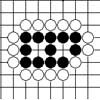
Sufficient but Not Necessary: Two Eyes and Seki in Go
The game of go has a simple mechanism. This discussion of the principle of two eyes in go has shown that the game does not depend on equally clear-cut concepts.
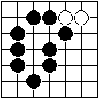
Behind the Rules of Go
This article explains the use of the idea of connectedness in networks, in two different ways, to bring into focus the basics of the game of Go, namely capture and territory.
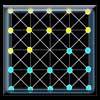
Alquerque
This game for two, was played in ancient Egypt as far back as 1400 BC. The game was taken by the Moors to Spain, where it is mentioned in 13th century manuscripts, and the Spanish name Alquerque derives from the Arabic El- quirkat. Watch out for being 'huffed'.
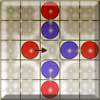
Seega
An ancient game for two from Egypt. You'll need twelve distinctive 'stones' each to play. You could chalk out the board on the ground - do ask permission first.
Game of PIG - Sixes
Can you beat Piggy in this simple dice game? Can you figure out Piggy's strategy, and is there a better one?
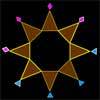
Mu Torere
Try playing this game from New Zealand at the beach by drawing the board in the sand. Find an opponent and see if you can win by ending up with your shell in the centre space.
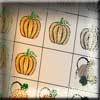
Pumpkin Patch
A game for two players based on a game from the Somali people of Africa. The first player to pick all the other's 'pumpkins' is the winner.

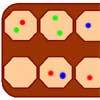
Wari
This is a simple version of an ancient game played all over the world. It is also called Mancala. What tactics will increase your chances of winning?


Jam
To avoid losing think of another very well known game where the patterns of play are similar.
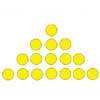
One, Three, Five, Seven
A game for 2 players. Set out 16 counters in rows of 1,3,5 and 7. Players take turns to remove any number of counters from a row. The player left with the last counter looses.
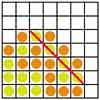
Low Go
A game for 2 players. Take turns to place a counter so that it occupies one of the lowest possible positions in the grid. The first player to complete a line of 4 wins.
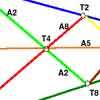
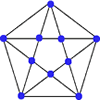
Pentanim
A game for 2 players with similarities to NIM. Place one counter on each spot on the games board. Players take it is turns to remove 1 or 2 adjacent counters. The winner picks up the last counter.
Slippery Snail
A game for two people, who take turns to move the counters. The player to remove the last counter from the board wins.
Sprouts
A game for 2 people. Take turns joining two dots, until your opponent is unable to move.

Mulinello Quadrupio
A game from Italy. Play with a friend and see if you can be the first to get five pieces in a line.
Dominoes
Everthing you have always wanted to do with dominoes! Some of these games are good for practising your mental calculation skills, and some are good for your reasoning skills.
Sz'kwa
This Chinese game for two players is a simple version of Wei ch'i or Go. Each player has 20 distinctive pieces - try coins, pebbles, shells. You could try marking the board out in wet sand.
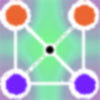
Two Stones
This game is known as Pong hau k'i in China and Ou-moul-ko-no in Korea. Find a friend to play or try the interactive version online.
Stop or Dare
All you need for this game is a pack of cards. While you play the game, think about strategies that will increase your chances of winning.
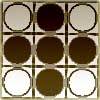
Turnablock
A simple game for 2 players invented by John Conway. It is played on a 3x3 square board with 9 counters that are black on one side and white on the other.
Football World Cup Simulation
A maths-based Football World Cup simulation for teachers and students to use.

Yih or Luk Tsut K'i or Three Men's Morris
Some puzzles requiring no knowledge of knot theory, just a careful inspection of the patterns. A glimpse of the classification of knots and a little about prime knots, crossing numbers and knot arithmetic.
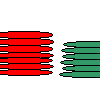
Nim
Start with any number of counters in any number of piles. 2 players take it in turns to remove any number of counters from a single pile. The loser is the player who takes the last counter.