Links to the University of Cambridge website
 Links to the NRICH website Home page

Links to the NRICH website Home page
Nurturing young mathematicians: teacher webinars
30 April (Primary), 1 May (Secondary)
30 April (Primary), 1 May (Secondary)
Diagonal Sums Sudoku
Age 7 to 16
Challenge Level 

by Henry Kwok
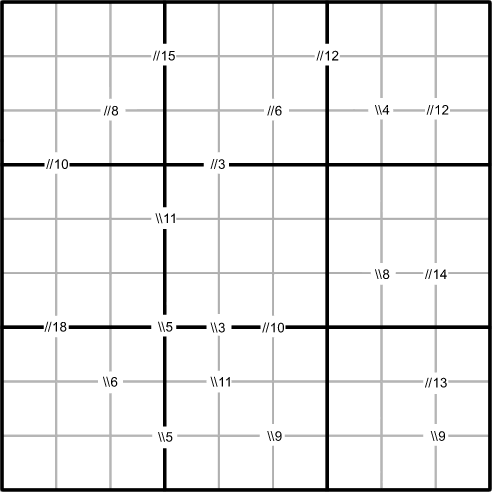
Rules of Diagonal Sums Sudoku
Like the standard Sudoku, this Sudoku has two basic rules:- Each column, each row and each box (3$\times$3 subgrid) must have the numbers 1 to 9.
- No column, row or box can have two squares with the same number.
The puzzle can be solved with the help of clue-numbers which
are written after slash marks on the intersections of border lines.
Each clue-number is the sum of two digits in the two squares that
are diagonally adjacent to each other. The position of each pair of
diagonally adjacent squares is indicated by either two forward
slash marks // or two backward slash marks \\.
For example, the //12 on the border of the top right hand box
means that possible pairs of numbers in the cells above-right and
below left are:
3 and 9, 9 and 3; 4 and 8, 8 and 4; 5 and 7, or 7 and 5
respectively.
Similarly, the \\6 in the bottom left box means that possible
pairs of numbers in the cells above-left and below-right are:
1 and 5, 5 and 1; 2 and 4, or 4 and 2 respectively.