

On this page you can find interactive environments, games and problems for Secondary learners.
Interactive environments
These general interactive environments can be used to support learners' work on a variety of activities.
-
 interactivityFavourite
Dice and Spinners Interactive
Simple dice and spinners tool for experiments.
-
 interactivityFavourite
Cuisenaire Environment
Age5 to 16Challenge level

An environment which simulates working with Cuisenaire rods.
-
 interactivityFavourite
Dominoes Environment
Age5 to 16Challenge level
These interactive dominoes can be dragged around the screen.
-
 interactivityFavourite
Virtual Geoboard
This virtual geoboard allows you to create shapes by stretching rubber bands between pegs on the board.
-
 interactivityFavourite
Tessellation Interactivity
Age7 to 16Challenge level
An environment that enables you to investigate tessellations of regular polygons
Interactive activities
These problems and games all have interactive content, making them ideal for students to tackle on tablets or laptops.
-
 problemFavourite
Stars
Age11 to 14Challenge level
Can you work out what step size to take to ensure you visit all the dots on the circle?
-
 problemFavourite
Subtended Angles
Age11 to 14Challenge level
What is the relationship between the angle at the centre and the angles at the circumference, for angles which stand on the same arc? Can you prove it?
-
 problemFavourite
Right Angles
Age11 to 14Challenge level
Can you make a right-angled triangle on this peg-board by joining up three points round the edge?
-
 problemFavourite
Two's Company
Age11 to 14Challenge level
Seven balls are shaken. You win if the two blue balls end up touching. What is the probability of winning?
-
 problemFavourite
Cosy Corner
Age11 to 14Challenge level
Six balls are shaken. You win if at least one red ball ends in a corner. What is the probability of winning?
-
 problemFavourite
Speeding Up, Slowing Down
Age11 to 14Challenge level
Experiment with the interactivity of "rolling" regular polygons, and explore how the different positions of the dot affects its speed at each stage.
-
 problemFavourite
What Numbers Can We Make Now?
Age11 to 14Challenge level
Imagine we have four bags containing numbers from a sequence. What numbers can we make now?
-
 problemFavourite
Estimating Time
Age11 to 14Challenge level
How well can you estimate 10 seconds? Investigate with our timing tool.
-
 problemFavourite
Rollin' Rollin' Rollin'
Age11 to 14Challenge level
Two circles of equal radius touch at P. One circle is fixed whilst the other moves, rolling without slipping, all the way round. How many times does the moving coin revolve before returning to P? -
 problemFavourite
Up and Across
Age11 to 14Challenge level
Experiment with the interactivity of "rolling" regular polygons, and explore how the different positions of the dot affects its vertical and horizontal movement at each stage.
-
 gameFavourite
Diamond Collector
Age11 to 16Challenge level
Collect as many diamonds as you can by drawing three straight lines.
-
 problemFavourite
Square It
Age11 to 16Challenge level
Players take it in turns to choose a dot on the grid. The winner is the first to have four dots that can be joined to form a square.
-
 problemFavourite
Arithmagons
Age11 to 16Challenge level
Can you find the values at the vertices when you know the values on the edges?
-
 problemFavourite
Fractions and Percentages Card Game
Age11 to 16Challenge level
Can you find the pairs that represent the same amount of money?
-
 problemFavourite
Semi-regular Tessellations
Age11 to 16Challenge level
Semi-regular tessellations combine two or more different regular polygons to fill the plane. Can you find all the semi-regular tessellations?
-
 problemFavourite
Countdown Fractions
Age11 to 16Challenge level
Here is a chance to play a fractions version of the classic Countdown Game.
-
 problemFavourite
Cyclic Quadrilaterals
Age11 to 16Challenge level
Draw some quadrilaterals on a 9-point circle and work out the angles. Is there a theorem?
-
 problemFavourite
Charlie's Delightful Machine
Age11 to 16Challenge level
Here is a machine with four coloured lights. Can you develop a strategy to work out the rules controlling each light?
-
 problemFavourite
Parallelogram It
Age11 to 16Challenge level
Players take it in turns to choose a dot on the grid. The winner is the first to have four dots that can be joined to form a parallelogram.
-
 problemFavourite
Magic Potting Sheds
Age11 to 16Challenge level
Mr McGregor has a magic potting shed. Overnight, the number of plants in it doubles. He'd like to put the same number of plants in each of three gardens, planting one garden each day. Can he do it?
-
 problemFavourite
Pythagoras Proofs
Age11 to 16Challenge level
Can you make sense of these three proofs of Pythagoras' Theorem?
-
 problemFavourite
Robotic Rotations
Age11 to 16Challenge level
How did the the rotation robot make these patterns?
-
 problemFavourite
Rhombus It
Age11 to 16Challenge level
Players take it in turns to choose a dot on the grid. The winner is the first to have four dots that can be joined to form a rhombus.
-
 problemFavourite
Nine Colours
Age11 to 16Challenge level
Can you use small coloured cubes to make a 3 by 3 by 3 cube so that each face of the bigger cube contains one of each colour?
-
 problemFavourite
More Magic Potting Sheds
Age11 to 16Challenge level
The number of plants in Mr McGregor's magic potting shed increases overnight. He'd like to put the same number of plants in each of his gardens, planting one garden each day. How can he do it? -
 problemFavourite
Crossing the Bridge
Age11 to 18Challenge level
Four friends must cross a bridge. How can they all cross it in just 17 minutes?
-
 problemFavourite
Beelines
Age14 to 16Challenge level
Is there a relationship between the coordinates of the endpoints of a line and the number of grid squares it crosses?
-
 problemFavourite
A Little Light Thinking
Age14 to 16Challenge level
Here is a machine with four coloured lights. Can you make two lights switch on at once? Three lights? All four lights?
-
 problemFavourite
Finding Factors
Age14 to 16Challenge level
Can you find the hidden factors which multiply together to produce each quadratic expression?
-
 problemFavourite
Attractive Tablecloths
Age14 to 16Challenge level
Charlie likes tablecloths that use as many colours as possible, but insists that his tablecloths have some symmetry. Can you work out how many colours he needs for different tablecloth designs?
-
 problemFavourite
A Question of Scale
Age14 to 16Challenge level
Use your skill and knowledge to place various scientific lengths in order of size. Can you judge the length of objects with sizes ranging from 1 Angstrom to 1 million km with no wrong attempts?
-
 problemFavourite
At Right Angles
Age14 to 16Challenge level
Can you decide whether two lines are perpendicular or not? Can you do this without drawing them?
-
 problemFavourite
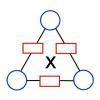
Multiplication Arithmagons
Age14 to 16Challenge level
Can you find the values at the vertices when you know the values on the edges of these multiplication arithmagons?
-
 problemFavourite
Guesswork
Age14 to 16Challenge level
Ask a friend to choose a number between 1 and 63. By identifying which of the six cards contains the number they are thinking of it is easy to tell them what the number is.
-
 problemFavourite
Which Spinners?
Age14 to 18Challenge level
Can you work out which spinners were used to generate the frequency charts?
-
 problemFavourite
Power Match
Age16 to 18Challenge level
Can you locate these values on this interactive logarithmic scale?
-
 problemFavourite
Direct Logic
Age16 to 18Challenge level
Can you work through these direct proofs, using our interactive proof sorters?
-
 problemFavourite
Interactive Workout - Mathmo
Age16 to 18Challenge level
Mathmo is a revision tool for post-16 mathematics. Give yourself a mathematical workout!