


article
Sums of Squares and Sums of Cubes
An account of methods for finding whether or not a number can be written as the sum of two or more squares or as the sum of two or more cubes.
An account of methods for finding whether or not a number can be written as the sum of two or more squares or as the sum of two or more cubes.

Suppose A always beats B and B always beats C, then would you expect A to beat C? Not always! What seems obvious is not always true. Results always need to be proved in mathematics.

Peter Zimmerman from Mill Hill County High School in Barnet, London gives a neat proof that: 5^(2n+1) + 11^(2n+1) + 17^(2n+1) is divisible by 33 for every non negative integer n.
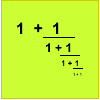
In this article we show that every whole number can be written as a continued fraction of the form k/(1+k/(1+k/...)).

Fractional calculus is a generalisation of ordinary calculus where you can differentiate n times when n is not a whole number.

An article about the strategy for playing The Triangle Game which appears on the NRICH site. It contains a simple lemma about labelling a grid of equilateral triangles within a triangular frame.
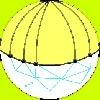
Here is a proof of Euler's formula in the plane and on a sphere together with projects to explore cases of the formula for a polygon with holes, for the torus and other solids with holes and the relationship between Euler's formula and angle deficiency of polyhedra.

This follows up the 'magic Squares for Special Occasions' article which tells you you to create a 4by4 magicsquare with a special date on the top line using no negative numbers and no repeats.
Freddie Manners, of Packwood Haugh School in Shropshire solved an alphanumeric without using the extra information supplied and this article explains his reasoning.