 Links to the NRICH website Home page

30 April (Primary), 1 May (Secondary)
Resources tagged with: Reading, writing and representing numbers
There are 36 NRICH Mathematical resources connected to Reading, writing and representing numbers, you may find related items under Place value and the number system.
Broad Topics > Place value and the number system > Reading, writing and representing numbers
Standard Index Form Matching
Can you match these calculations in Standard Index Form with their answers?



Eightness of Eight
What do you see as you watch this video? Can you create a similar video for the number 12?

Number Lines in Disguise
Some of the numbers have fallen off Becky's number line. Can you figure out what they were?

Representing Numbers
Find as many different ways of representing this number of dots as you can.
Roman Numerals
Can you find some examples when the number of Roman numerals is fewer than the number of Arabic numerals for the same number?
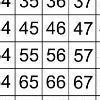
That Number Square
Exploring the structure of a number square: how quickly can you put the number tiles in the right place on the grid?

How Would We Count?
An activity centred around observations of dots and how we visualise number arrangement patterns.

Three Neighbours
Take three consecutive numbers and add them together. What do you notice?
Take Three Numbers
What happens when you add three numbers together? Will your answer be odd or even? How do you know?
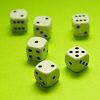
Dotty Six
Dotty Six is a simple dice game that you can adapt in many ways.
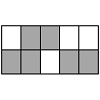
Number Match
A task which depends on members of the group noticing the needs of others and responding.

Even and Odd
This activity is best done with a whole class or in a large group. Can you match the cards? What happens when you add pairs of the numbers together?
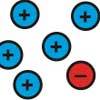
Adding and Subtracting Positive and Negative Numbers
How can we help students make sense of addition and subtraction of negative numbers?
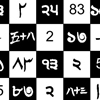
Which Scripts?
There are six numbers written in five different scripts. Can you sort out which is which?
Neighbourly Addition
I added together some of my neighbours' house numbers. Can you explain the patterns I noticed?
More Lower Primary Number Sense and Place Value Activities
More activities which will help you get a better of sense of numbers and understand what we mean by place value.
Amount
These tasks will help learners develop their understanding of place value, particularly giving them opportunities to express numbers as amounts.

Activities on the Gattegno Chart
In this article, Alf outlines six activities using the Gattegno chart, which help to develop understanding of place value, multiplication and division.
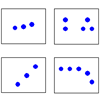
Dot Card Games
These games devised by Jenni Way use dot cards which will help children see the structure of numbers 1-6 and give them confidence as they begin to add and subtract these numbers.
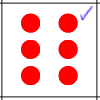
Dotty Six for Two
Dotty Six game for an adult and child. Will you be the first to have three sixes in a straight line?
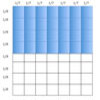
Models in Mind
This article looks at how models support mathematical thinking about numbers and the number system
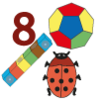
Matching Numbers
Can you find different ways of showing the same number? Try this matching game and see!
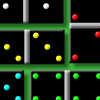
Dominoes Environment
These interactive dominoes can be dragged around the screen.


Balance Power
Using balancing scales what is the least number of weights needed to weigh all integer masses from 1 to 1000? Placing some of the weights in the same pan as the object how many are needed?

Numbers Numbers Everywhere!
Bernard Bagnall recommends some primary school problems which use numbers from the environment around us, from clocks to house numbers.
Lucky Numbers
This article for pupils explores what makes numbers special or lucky, and looks at the numbers that are all around us every day.
A Story about Absolutely Nothing
This article for the young and old talks about the origins of our number system and the important role zero has to play in it.
Arrow Arithmetic 1
The first part of an investigation into how to represent numbers using geometric transformations that ultimately leads us to discover numbers not on the number line.
Numbers and Notation - Ambiguities and Confusions
While musing about the difficulties children face in comprehending number structure, notation, etc., it occured to the author that there is a vast array of occasions when numbers and signs are used in anomalous ways; often these are at the earliest stages, when they must be enormously confusing. However, they also frequently happen in adult situations.

Stone Age Counting
What could these drawings, found in a cave in Spain, represent?

Multiplication Series: Illustrating Number Properties with Arrays
This article for teachers describes how modelling number properties involving multiplication using an array of objects not only allows children to represent their thinking with concrete materials, but it can also assist them in forming useful mental pictures to support memory and reasoning.

Multiplication Series: Number Arrays
This article for teachers describes how number arrays can be a useful representation for many number concepts.
A Romantic Riddle
Read this riddle and see if you can work out how the trees must be planted.