 Links to the NRICH website Home page

30 April (Primary), 1 May (Secondary)
Resources tagged with: Compound transformations
There are 27 results
Broad Topics > Transformations and constructions > Compound transformations
Who is the fairest of them all ?
Explore the effect of combining enlargements.

...on the Wall
Explore the effect of reflecting in two intersecting mirror lines.


Mirror, Mirror...
Explore the effect of reflecting in two parallel mirror lines.
Transformation Game
Why not challenge a friend to play this transformation game?
Paint Rollers for Frieze Patterns.
Proofs that there are only seven frieze patterns involve complicated group theory. The symmetries of a cylinder provide an easier approach.
Which Quadratic?
This task develops knowledge of transformation of graphs. By framing and asking questions a member of the team has to find out which mathematical function they have chosen.
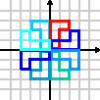
Grouping Transformations
An introduction to groups using transformations, following on from the October 2006 Stage 3 problems.
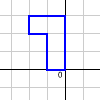
Simplifying Transformations
How many different transformations can you find made up from combinations of R, S and their inverses? Can you be sure that you have found them all?
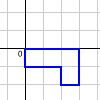
Combining Transformations
Does changing the order of transformations always/sometimes/never produce the same transformation?
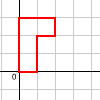
Decoding Transformations
See the effects of some combined transformations on a shape. Can you describe what the individual transformations do?
Mathematical Patchwork
Jenny Murray describes the mathematical processes behind making patchwork in this article for students.
Maurits Cornelius Escher
Have you ever noticed how mathematical ideas are often used in patterns that we see all around us? This article describes the life of Escher who was a passionate believer that maths and art can be intertwined.
Going Places with Mathematicians
This article looks at the importance in mathematics of representing places and spaces mathematics. Many famous mathematicians have spent time working on problems that involve moving and mapping things.
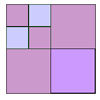
Squares, Squares and More Squares
Can you dissect a square into: 4, 7, 10, 13... other squares? 6, 9, 12, 15... other squares? 8, 11, 14... other squares?
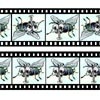
Matching Frieze Patterns
Sort the frieze patterns into seven pairs according to the way in which the motif is repeated.

Bow Tie
Show how this pentagonal tile can be used to tile the plane and describe the transformations which map this pentagon to its images in the tiling.
Trees and Friezes
This problem is based on the idea of building patterns using transformations.
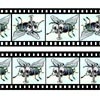
The Frieze Tree
Patterns that repeat in a line are strangely interesting. How many types are there and how do you tell one type from another?
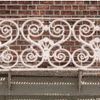
Frieze Patterns in Cast Iron
A gallery of beautiful photos of cast ironwork friezes in Australia with a mathematical discussion of the classification of frieze patterns.

Making Rectangles, Making Squares
How many differently shaped rectangles can you build using these equilateral and isosceles triangles? Can you make a square?
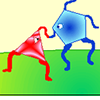
Flight of the Flibbins
Blue Flibbins are so jealous of their red partners that they will not leave them on their own with any other bue Flibbin. What is the quickest way of getting the five pairs of Flibbins safely to the new planet?
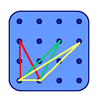
Triangular Tantaliser
Draw all the possible distinct triangles on a 4 x 4 dotty grid. Convince me that you have all possible triangles.
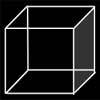
Counting Triangles
Triangles are formed by joining the vertices of a skeletal cube. How many different types of triangle are there? How many triangles altogether?
Squaring the Rectangle
Can you find a way to turn a rectangle into a square?
Screwed-up
A cylindrical helix is just a spiral on a cylinder, like an ordinary spring or the thread on a bolt. If I turn a left-handed helix over (top to bottom) does it become a right handed helix?
2001 Spatial Oddity
With one cut a piece of card 16 cm by 9 cm can be made into two pieces which can be rearranged to form a square 12 cm by 12 cm. Explain how this can be done.