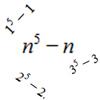
Take a complicated fraction with the product of five quartics top
and bottom and reduce this to a whole number. This is a numerical
example involving some clever algebra.
Two cubes, each with integral side lengths, have a combined volume equal to the total of the lengths of their edges. How big are the cubes? [If you find a result by 'trial and error' you'll need to prove you have found all possible solutions.]
Find all 3 digit numbers such that by adding the first digit, the
square of the second and the cube of the third you get the original
number, for example 1 + 3^2 + 5^3 = 135.
a) A four digit number (in base 10) aabb is a perfect square. Discuss ways of systematically finding this number.
(b) Prove that 11^{10}-1 is divisible by 100.
Given any 3 digit number you can use the given digits and name another number which is divisible by 37 (e.g. given 628 you say 628371 is divisible by 37 because you know that 6+3 = 2+7 = 8+1 = 9). The question asks you to explain the trick.
If a two digit number has its digits reversed and the smaller of the two numbers is subtracted from the larger, prove the difference can never be prime.