Odd differences
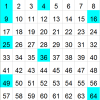
The diagram illustrates the formula: 1 + 3 + 5 + ... + (2n - 1) = n² Use the diagram to show that any odd number is the difference of two squares.
Can you explain the surprising results Jo found when she calculated the difference between square numbers?
A circle of radius r touches two sides of a right angled triangle, sides x and y, and has its centre on the hypotenuse. Can you prove the formula linking x, y and r?
Can you find a general rule for finding the areas of equilateral triangles drawn on an isometric grid?
A mother wants to share some money by giving each child in turn a lump sum plus a fraction of the remainder. How can she do this to share the money out equally?
Many numbers can be expressed as the difference of two perfect squares. What do you notice about the numbers you CANNOT make?
Take any prime number greater than 3 , square it and subtract one. Working on the building blocks will help you to explain what is special about your results.
Can you produce convincing arguments that a selection of statements about numbers are true?