Making Boxes
Cut differently-sized square corners from a square piece of paper to make boxes without lids. Do they all have the same volume?
Can you draw a square in which the perimeter is numerically equal to the area?
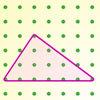
Use the interactivity to find all the different right-angled triangles you can make by just moving one corner of the starting triangle.
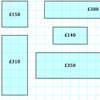
My local DIY shop calculates the price of its windows according to the area of glass and the length of frame used. Can you work out how they arrived at these prices?
Nine squares with side lengths 1, 4, 7, 8, 9, 10, 14, 15, and 18 cm can be fitted together to form a rectangle. What are the dimensions of the rectangle?
What is the largest 'ribbon square' you can make? And the smallest? How many different squares can you make altogether?
A task which depends on members of the group noticing the needs of others and responding.
It's easy to work out the areas of most squares that we meet, but what if they were tilted?
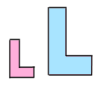
What happens to the area and volume of 2D and 3D shapes when you enlarge them?
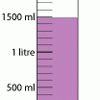
Can you rank these sets of quantities in order, from smallest to largest? Can you provide convincing evidence for your rankings?