

Learning Mathematics Through Games: 3. Creating Your Own Games
The previous two articles in this series can be found here (Why Games) and here (Types of Games)
Some games are worthy of playing in their own right - because they stimulate mathematical thinking and strategy development. However, to take full advantage of the educational benefits of playing games (and cope with a specified mathematics curriculum), we often need games that fit particular mathematical objectives. As the teacher, you are the best person to design a game for your class, or groups within your class. You know the children's mathematical abilities and needs. You also know the content that needs to be covered, and other constraints such as time, resources and space.
Not all of us a bursting with creative game ideas, but there are several ways to go about creating a game that will assist even the busiest and most reluctant game designer.
1.Use the rules of an existing game, but use different materials or add extra materials.
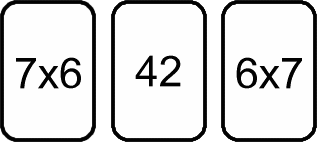
Example 1: Tables Fish - use the rules of the old favourite "Go Fish", but make a pack of cards for whichever multiplication facts need practising.



3.Use a game board and add maths tasks to it. Most schools have board games with pieces missing, like Ludo, Snakes and Ladders, Checkers, or racing games. Use the boards and make up some new rules and put in some mathematics. Rather than write tasks directly onto the boards, just place coloured stickers on certain spaces. Make up some colour-coded cards with quiz-type questions. A correct response - advance some spaces, incorrect - stay there. Include some fun questions and chance cards.
Example: Operation Snakes and Ladders - use the board with two dice. On each turn the player has the option of multiplying, dividing, adding or subtracting the two numbers, with a maximum answer of twenty.
4.Ask the children to invent their own games. Put them into small groups. Give them some possible topics, various resources and insist on an agreed plan before they start making anything.
Evaluating Your Game
Rate your game using these questions.
- Does the game match your mathematical objective?
- Does it cater for a range of abilities?
- Can the game be completed in a short time? (10 mins for infants, 15-20 for older)
- Is there an element of chance built in?
- Are there strategies to be developed to improve the likelihood of winning?
- Do the children enjoy playing it? (If not, ask them why and modify the game)
The next article in the series can be found here.