

Learning Mathematics Through Games Series: 2. Types of Games
The first article in this series discussed what is meant by 'mathematical games', and the possible benefits of using them as part of a teaching programme. This article looks at some different types of games and the sort of mathematical thinking they can develop.
One way of classifying games is by their format, that is; the equipment used and the sort of actions the players are involved in. Some of the following classification has been drawn from two articles by Gough (1999). Examples have been provided by referring to well-known games, 'hotlinks' to games that have been published on the Primary Website, or a brief description of a game. Some thoughts on the nature of mathematics involved are also given.
Game Formats
Races
These games involve racing pieces around or across a board to a finishing point, like Ludo. Other games might be a race against time.
Some race games depend on rote learnt skills, like basic counting or reciting number facts, and therefore have limited mathematical value. Such games also tend to have little interaction between players, or interdependence between 'turns' and therefore require little or no strategy development. However, race games can be deliberately designed to focus on particular mathematical skills, such as the probability game and the arithmetic game given below.
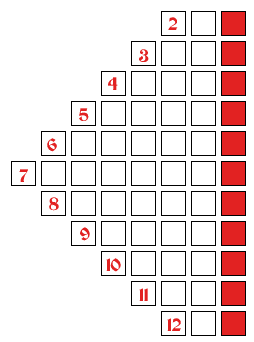
Fast Figuring
Using the number cards from an ordinary pack, deal out five cards to each player. Turn up one more card to reveal the 'target number'. Players race to use their five cards and any of the four operations (+, -, x, / ) to form a statement that results in the target number. The first player to do so wins a point. If, after 3 minutes, no one can find a solution, the players show their hands for checking, then cards are shuffled and play continues.
Board Games
Moving round a board to build to build towards a goal, like Monopoly. Whilst there is some mathematical value in these games, they are perhaps most useful in the classroom when adapted to include problems and puzzles, which when solved, give some advantage to the player (or players).
Spatial Strategy Games
Spatial Strategy: This might involve moving pieces around a board strategically, usually to capture or block an opponent, like Chess and Draughts (see Mini Draughts below). See Jumping Reindeer , Two Stones , and Roundabout .
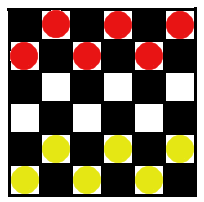
Mini Draughts
Draughts can be difficult for young children to learn. A reduction in the size of the game grid and the number of pieces can provide the challenge and interest of 'real' draughts without the overwhelming number of possibilities for moves.
Spatial strategy games involve placing pieces to make a pattern or seize territory, like Noughts and Crosses or Connect Four. See Line of Four , Endless Noughts and Crosses , Sprouts .
Numerical Strategy Games
This usually involves removing pieces to achieve a goal, like Nim or Mancala, See Last Biscuit , Squayles , Slippery Snail .
As suggested in the title, to be successful at strategy games, players need to analyse the 'moves' and patterns of moves that lead to winning. This is where the underlying mathematics is discovered! Once the patterns have been found and practised, the games lose their appeal, but can be revived through variations and extensions.
Card Games
Using a pack of cards: taking tricks, building sets, emptying one's hand, like Rummy, Fish or Old Maid. These can be further adapted to create more mathematical games (see January's article).
Arithmetical Games
These games might use cards (like ONO'99), dice (like Number Boggle) or targets (like Darts) to deliver the numbers that are then calculated in some way according to a set of rules. The games usually involve an element of chance, which adds more interest.
See also Stop or Dare
Matching Games
Using a set of tiles, matching ends or making patterns, like Dominoes and the less known number game Triominoes. Memory (under its many other names) involves turning a set of pairs of cards face down and trying to locate the pairs turning only two cards face-up at a time.
This type of game is very useful for practise and consolidation of basic number skills, particularly with very young children, but usually involves little strategy or player interaction.
Mystery Games
Guess My Number and Twenty Questions type games can stimulate quite a lot of mathematical thinking and strategy development.
Teachers, take advantage of the fact that children will happily play and enjoy mathematical games that they wouldn't normally choose to play at home!
The next article in the series can be found here.
References