

Playing Squash
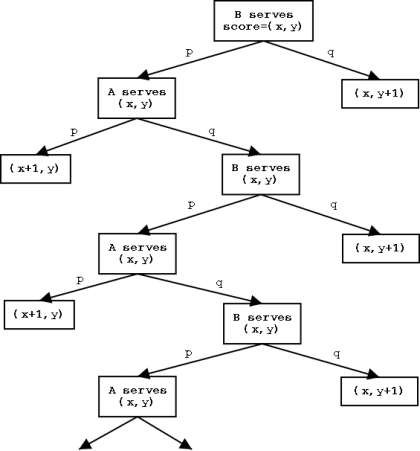
Let us find $\theta$. One possibility is that $A$ wins the first rally, and hence the first point; he does this with probability $p$. If not, he loses it with probability $q$ and $B$ then serves. Then for $A$ to win the next point he must win the next rally (with probability $p$) and then the situation returns to that in which $A$ serves and wins the next point with probability $\theta$. Thus $\theta = p + qp\theta$, and hence \[Pr(\hbox{A wins the next point given that A serves first})= \theta = {p\over 1-pq}.\] Next, we find $\varphi$. As $B$ serves first, $A$ must win the next rally (with probability $p$). The position now is that $A$ is serving and must win the next point (which he does with probability $\theta$). Thus $\varphi = p\theta$, and hence \[ Pr(\hbox{A wins the next point given that B serves first})= \varphi ={p^2\over 1-pq}.\] By interchanging $A$ with $B$, and $p$ with $q$, we see that \[Pr(\hbox{B wins the next point given that A serves first})= \lambda ={q^2\over 1-pq},\] and \[Pr(\hbox{B wins the next point given that B serves first})= \mu ={q\over 1-pq}.\] Note that \[ Pr(\hbox{A or B wins the next point given that B serves first})= \varphi + \mu, \] and \[\varphi + \mu = {p^2\over 1-pq}+ {q\over 1-pq} ={p(1-q)+q\over 1-pq}={p+q-pq\over 1-pq}={1-pq\over 1-pq}=1.\] It follows that if $B$ serves first, then the probability that $A$ or $B$ eventually wins a point is one; hence the probability that the game goes on for ever is zero! You may like to draw a tree diagram to illustrate this, and you will find that a succession of rallies in which nobody scores a point is represented by a long 'zig-zag' in your tree diagram. The start of the tree diagram is given below.
The rules of squash say that if the position is reached when the score is $(8,8)$ (we give A's score first), and $B$ is to serve, then $A$ must choose between the game ending when the first player reaches $9$ or when the first player reaches $10$. We want to decide what is the best choice for $A$ to make (when $p$ and $q$ are known).
If $A$ chooses $9$, then he wins the game with probability $\varphi$. Suppose now that $A$ chooses $10$; then the sequence of possible scores and their associated probabilities are as follows:
| Sequence of scores | Probability | Probability in terms of $p,q$ |
|---|---|---|
| $(8,8) \to (9,8) \to (10,8)$ | $\varphi \times \theta$ | $p^3/(1-pq)^2$ |
| $(8,8)\to (8,9)\to (9,9) \to (10,9)$ | $\mu\times\varphi\times\theta$ | $p^3q/(1-pq)^3$ |
| $(8,8) \to (9,8) \to (9,9) \to (10,9)$ | $\varphi \times \lambda\times \varphi$ | $p^4q^2/(1-pq)^3$ |