

Just Rolling Round

P is a point on the circumference of a circle radius r which rolls, without slipping, inside a circle of radius 2r. What is the locus of P?
Problem
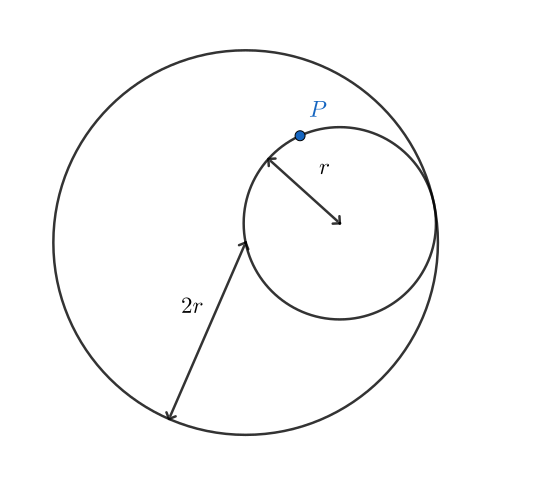
A circle of radius $r$ rolls around inside the circumference of a larger circle of radius $2r$, without slipping.
$P$ is a point on the circumference of the smaller circle.
What is the locus of $P$?
Getting Started
Experiment with some diagrams and make your own conjecture about the locus of $P$.
As the small circle moves, points on the small circle come into contact with points on the big circle. Think about the lengths of the arcs on the two circles that are made up of the points that have come into contact.
Student Solutions
Tomas of Malmsbury School, Mark of The British School of Manilla and Herbert of Sha Tin College, Hong Kong sent good solutions to this problem. Well done all of you.
$P$ is a point on the circumference of a circle radius $r$ which touches another circle radius $2r$ on the inside. The smaller circle rolls, without slipping, around the inner circumference of the larger circle.
The point $P$ is a fixed point on the smaller circle which moves as the small circle moves. The point $P_o$ is the position of $P$ when $P$ is at the point of contact between the two circles. Consider the general position where the point of contact is the point $C$ but here we do not assume that $P_1$ is the position of the point $P$. Image

|
Teachers' Resources
Using NRICH Tasks Richly describes ways in which teachers and learners can work with NRICH tasks in the classroom.
Why do this problem?
In this problem, learners can use diagrams to experiment and make their own conjectures about the locus. The proof requires only simple geometrical reasoning involving circle theorems and arc lengths.
Possible approach
Learners might first experiment with drawing some diagrams and make a conjecture about the locus, then try to prove their conjecture.
Key question
We know the small circle rolls around inside the big one. What can we say about arc lengths?
Possible support
Learners might draw their own interactive diagrams using Geogebra.
Ask about how far a bicycle goes forward when the wheels rotate through exactly one revolution.
What about a revolution by a given angle?
What if the road was curved?
Possible extension
See the problem Illusion.