

Watch the Clock

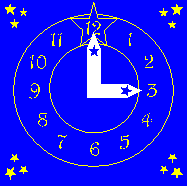
During the third hour after midnight the hands on a clock point in the same direction (so one hand is over the top of the other). At what time, to the nearest second, does this happen?
Problem
During the third hour after midnight the hands on a clock pointed in the same direction (so one hand was over the top of the other).
At what time, to the nearest second, did this happen?

Getting Started
What is the earliest time it could be?
How do you know?
What is the latest time it could be?
How do you know?
Can you get any closer?
Student Solutions
This challenge caused a lot of hard thinking. Some took the time to be around 2.10 and others around 3.15 according to how they interpreted the question. Either way led to some careful working out. The amount the small hour hand moves led to slightly different suggested answers.
Hasa, Javeria and Sarah wrote:
First we estimated an answer. The answer must be between 2 and 3 on the clock. So it must be between 2:10 and 2:15. Then we worked out how many degrees each hand moves in 1 minute.
The minute hand moves $360\div60=6$ degrees per minute.
The hour hand moves $(360\div12)\div60=0.5$ degrees per minute.
If $T$ is the time in minutes after 2:00 then the minute hand has moved $6T$ degrees.
The hour hand has moved $60+0.5T$
When the hands are pointing in the same direction these must be equal
$6T=60+0.5T$
$5.5T=60$
$T=60\div5.5$
$= 120\div11$
$= 10$ min$+10\div11$ x $60$ sec
= $10$ min $55$ sec (to the nearest second) after 2:00
Isobel sent in her suggestion as:
Teachers' Resources
Watch the Clock
During the third hour after midnight the hands on a clock pointed in the same direction (so one hand was over the top of the other).
At what time, to the nearest second, did this happen?
Using NRICH Tasks Richly describes ways in which teachers and learners can work with NRICH tasks in the classroom.
Why do this problem?
Possible approach
Key questions
Possible extension
Possible support