

Tessellating Triangles


Problem
| Equilateral triangles have three sides the same length and three angles the same. Can you make them fit together to cover the paper without any gaps between them? This is called 'tessellating'. | Image

|
What about triangles with two equal sides? These are isosceles triangles.
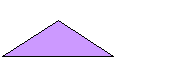
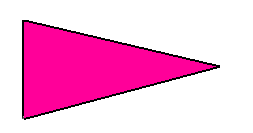
Can you tessellate all isosceles triangles?
Now try with right angled triangles. These have one right angle or 90 degree angle.
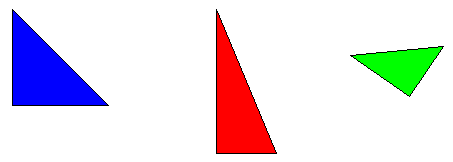
Some triangles have sides that are all different. Can you tessellate these?
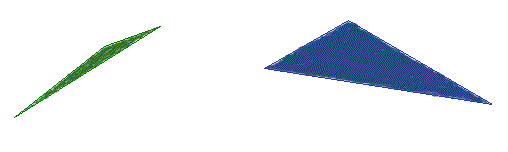
Could you tessellate any triangle?
Getting Started
Student Solutions
There are lots of interesting designs to be made by tessellating triangles. Have a go yourself, and if you discover anything interesting, email primary.nrich@maths.org to tell us what you've done!
Please don't worry that your solution is not "complete" - we'd like to hear about anything you have tried.
Teachers - you might like to send in a summary of your children's work.
Teachers' Resources
Tessellating Triangles
| Equilateral triangles have three sides the same length and three angles the same. Can you make them fit together to cover the paper without any gaps between them? This is called 'tessellating'. | Image
|
What about triangles with two equal sides? These are isosceles triangles.
Can you tessellate all isosceles triangles?
Now try with right angled triangles. These have one right angle or 90 degree angle.
Some triangles have sides that are all different. Can you tessellate these?
Could you tessellate any triangle?
Why do this problem?
This problem encourages children to use the right vocabulary when talking about shape properties. They will begin to understand that, for a shape to tessellate, the angles where they come together are important.Possible approach
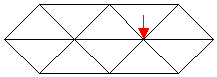
- If I took out one of the triangles, how do I know which way it fits in to make the tessellation?
- Why won't it fit if the triangle is rotated?