


2010: A Year of Investigations
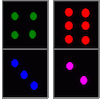
A Good Foundation for Number Learning for Five Year Olds?
This article, written by Dr. Sue Gifford, evaluates the Early Learning Numbers Goal in England, in the light of research.

A Japanese Mathematics Lesson
Jenni Way describes her visit to a Japanese mathematics classroom.

A Maths Afternoon
This article describes no ordinary maths lesson. There were 24 children, mostly Years 3 and 4, and there were 17 adults working with them - mothers, fathers, one grandmother and two grandfathers, a classroom assistant and their regular teacher. Every child was working with an adult, and no two adults sat together.

A New Challenge

A Problem Is a Problem for All That

A Random Rambling Rant
A random ramble for teachers through some resources that might add a little life to a statistics class.

Acme Report: Developing Able Young Mathematicians
Lynne McClure gives an overview of the ACME report 'Raising the bar: developing able young mathematicians', published in December 2012.

Activities on the Gattegno Chart
In this article, Alf outlines six activities using the Gattegno chart, which help to develop understanding of place value, multiplication and division.
Appreciating Different Approaches

Approaches to Area

Articles on Mathematical Topics

Assessing Pupil Progress (APP) and NRICH Resources
In this article Jenny talks about Assessing Pupils' Progress and the use of NRICH problems.
Back to the Practical?
Balances
In this activity, children will use the language of weight when comparing objects on a balance scale.

Balancing Act
This book builds on children's experience of seesaws and balancing. Join the two mice who make a seesaw (or teeter totter) and see what happens as their friends hop on too.
Barrier Games
Barrier games build on children's natural desire to combine block play with small world items.
Baskets
This activity encourages children to practise their sharing and counting skills by putting small objects into some baskets.
Beat the Clock
Children use everyday language to talk about time, to compare quantities and to solve problems