

Squaring the Rectangle
Age
14 to 18
Challenge level

 2 out of 3
Can you find a way to turn a rectangle into a square?
Problem
Draw a rectangle on a piece of paper, and cut it out.
Can you find a way to cut your rectangle into pieces that can be reassembled to make a square?
Try to do it using the smallest number of pieces you can.
Is it always possible to cut up and reassemble a rectangle into a square using finitely many pieces?
Here are some suggestions to help you to think about this question:
Start with a rectangle with dimensions in the ratio 2:1. What side length do you need your square to have? How could you construct it?
Start with a square. How many different ways can you find to cut it into two pieces to make a rectangle? Or three pieces?
Click below to find an interactivity which shows one way of cutting up and reassembling a square to make a rectangle.
Can you move the pieces to make a square?
Can you move the pieces to make a rectangle?
Slide the point on the side of the square to change the pieces.
Move and rotate each piece using the blue dots.
Can you work out how the pieces were constructed?
Can you find a way to cut your rectangle into pieces that can be reassembled to make a square?
Try to do it using the smallest number of pieces you can.
Is it always possible to cut up and reassemble a rectangle into a square using finitely many pieces?
Here are some suggestions to help you to think about this question:
Start with a rectangle with dimensions in the ratio 2:1. What side length do you need your square to have? How could you construct it?
Start with a square. How many different ways can you find to cut it into two pieces to make a rectangle? Or three pieces?
Click below to find an interactivity which shows one way of cutting up and reassembling a square to make a rectangle.
Can you move the pieces to make a square?
Can you move the pieces to make a rectangle?
Slide the point on the side of the square to change the pieces.
Move and rotate each piece using the blue dots.
Can you work out how the pieces were constructed?
Getting Started
Here is a rectangle drawn on a set of axes. If the top right corner of the rectangle has coordinates (a, b), how could you calculate the coordinates of the other dots?

Image
Student Solutions
Minh from BVIS in Vietnam sent an image of the pieces from the interactivity made into a square. This in Minh's image:
Image

Image

Image

Laiba from Doha College in Qatar made a beautiful poster with details of several different approaches.
Click here to see a larger version of Laiba's poster.
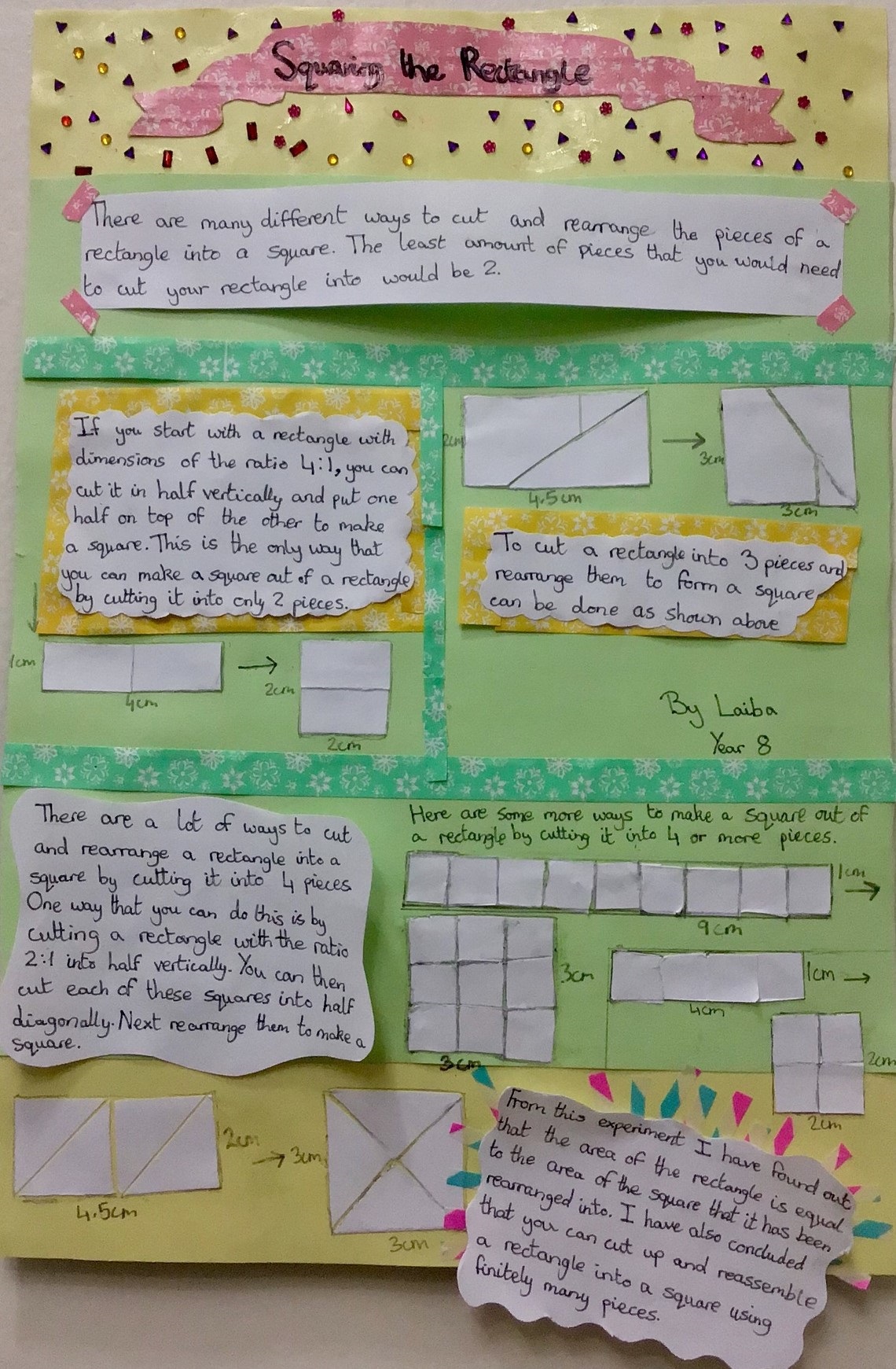
Minee & Pin M & Gor-Bua from Bangkok Patana School in Thailand and Ana also used a rectangle with dimensions in the ratio 2:1. Ana started with this rectangle:
The rectangle has length to width ratio $2:1.$ As an example the width is $1$ cm and the length is $2$ cm.
Image

Image

The area of the rectangle and square must be equal. In this case it must be $2$ cm$^2$. The square has equal length sides and therefore the sides will have length $\sqrt2$ cm.
If the second rectangle drawn is cut into four pieces, across the diagonal of each $1\times 1$ square which is shown right, then the length of diagonals will be $1^2+1^2=a^2$ and thus $a=\sqrt2.$
The yellow triangle's hypotenuse has length $\sqrt2,$ which is the [side] length of the square which will be constructed. A total of four yellow triangles can be cut out from the original rectangle and rearranged to create a square like this:
Image

The triangles had length $ \sqrt2$ and two sides with length $1.$ The diagonal of the square is $2,$ which is equal to $2$ times $1$ cm, the width and half of the length of the previous rectangle.
This can be done with any triangle with ratio $2:1.$ Instead of the sides being $2$ and $1$ they can be called $a$ and $2a.$ The area of the rectangle and square would then be $2a^2.$ The sides of the square are $\sqrt2a.$
This formula can be [verified] with our example of sides $2$ and $1.$ If $1$ is $a$ then the sides of the square is $\sqrt2\ast1=\sqrt2$
Minee & Pin M & Gor-Bua proved that this formula works:
Because the lengths are "$a$" and "$2a$", to find the area of the rectangle you'll have to do $a \times 2a = 2a^2$
Because we are not cutting out any of the rectangle's area, the area of the square must be $2a^2$
To find the side lengths of the square you'll have to do $\sqrt{(2a^2)}$ because you have to do $x\times x$ to find the area ($x=\sqrt{(2a^2)}$).
David from LAE Tottenham in the UK generalised Min's method so that it will work for any rectangle:
Take any rectangle of size $a\times b$:
Image

height $=a$
width $=b$ where $a$ and $b$ are positive and $\left \lfloor \frac {b}{a} \right \rfloor= 1$
Where $\left \lfloor x \right \rfloor$ means the highest whole number $n$ which is less than or equal to $x$ (i.e. $x$ rounded down to the nearest whole number).
Image

This process could be repeated $N$ times, and eventually $\left \lfloor \frac ba \right \rfloor =1,$ which means that it can be transformed into a square.
It should be done as follows:
1. Start with the rectangle of size $a \times b$ where $\left \lfloor \frac ba \right \rfloor > 1.$
Image

2. Find the highest square number $n^2$ fitting into $b$ such that $\left \lfloor \frac an \right \rfloor =1$ or $\left \lfloor \frac na \right \rfloor =1.$ Divide $b$ into $n^2$ even lengths (Note $\frac b {n^2}$ doesn't have to be an integer), forming new rectangles ($n=2$ shown in example)
Image

3. Perform the previous method on each rectangle, to get $n^2$ squares of area $\frac{ab}{n^2}:$
Image

4. Rearrange the pieces to form squares:
Image

each square has area $\frac{ab}{n^2},$ but there are $n^2$ squares, so the total area is still $ab^2$
5. Since there are $n^2$ squares, and $n^2$ is a square number, the rectangle can be rearranged into a square of area $ab$.
Image

Teachers' Resources
Using NRICH Tasks Richly describes ways in which teachers and learners can work with NRICH tasks in the classroom.
Why do this problem?
This problem encourages students to think deeply about area and length in order to prove a theorem. The suggestions and interactivity in the task provide some scaffolding to help students to investigate, make conjectures, and hopefully prove some of their conclusions. To get to a complete proof will require some perseverance.Possible approach
You may wish to spend some time working on Triangle Transformations before starting on this problem."Draw a rectangle with any dimensions that you like. Your challenge is to find a way to cut it up and reassemble it to make a square."
Students may start by picking particular rectangles that can be easily rearranged. After they have had some time to explore, you may wish to share the interactivity below:
Invite students to work out how the square has been cut up, and how they could reverse-engineer this to start with a rectangle and finish up with a square.
Alternatively, you might wish to share the image below, and invite them to consider how the pieces could be rearranged to make a square.
It might be fruitful to discuss the side length of a square which has the same area as a rectangle with sides of length $a$ and $b$: "If the top right corner of the rectangle has coordinates (a, b), how could you calculate the coordinates of the other dots?"
Image
Key questions
How do the pieces move to turn a square into a rectangle and back again?How could you identify the points which are needed to make the pieces?
Can every rectangle be cut up and reassembled to make a square?