

Cyclic Quad Jigsaw

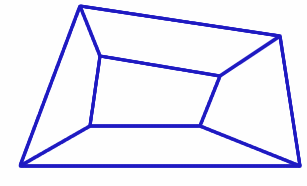
A picture is made by joining five small quadrilaterals together to make a large quadrilateral. Is it possible to draw a similar picture if all the small quadrilaterals are cyclic?
Problem
Someone showed me this picture of a quadrilateral made by joining together five smaller quadrilaterals.
Student Solutions
We had two very clear solutions to this problem - well done to James, from Poole Grammar School, and Dylan, who did not give his school. James's solution is shown here.

Teachers' Resources
Using NRICH Tasks Richly describes ways in which teachers and learners can work with NRICH tasks in the classroom.
Why do this problem?
First, the surprising amount of variation in possibilities shown in the video is worth the journey. Secondly, even though there is such variation the outer quadrilateral is always cyclic.Finally, specialising by trying numbers can help form a map of the journey you need to make in order to prove the generalisation for any cyclic quadrilaterals.
Possible approach
The first stage is simply to investigate:
Construct an image with the given constraints either using dynamic geometry or with a ruler and compasses. Using ruler and compasses is difficult simply because you need some flexibility to ensure a reasonable overlap of the circles.
Are learners surprised by the flexibility visible in the dynamic image?
Allow time for lots of discussion about construction techniques, the order of working (formed by the constraints) and the freedoms available (how many circles will meet the cirteria?).
Now for the problem.
A first step is to encourage exploration by writing in some angle sizes (following a discussion of the properties of opposite angles of a cyclic quadrilateral). Does the outside quadrilateral have opposite angles whose sum is 180 degrees and is therefore cyclic?
In specialising by using numbers for angles and keeping track of which angles can be calculated from others, the steps to a generalisation are much clearer.
Key questions
- What defines a cyclic quadrilateral?
- What are the freedoms?
- What the contraints?
Possible support
Focus on the construction and looking at specific examples.
For work on cyclic quadrilaterals try Pegboard Quads.