

Inclusion Exclusion
 3 out of 3
How many integers between 1 and 1200 are NOT multiples of any of the numbers 2, 3 or 5?
Problem

How many integers between 1 and 1200 are NOT multiples of any of the numbers 2, 3 or 5?
Getting Started
How many integers between 1 and 1200 are multiples of 2?
How many integers between 1 and 1200 are multiples of 3?
How many integers between 1 and 1200 are multiples of 5?
Some integers are multiples of both 2 and 3, of both 2 and 5, of both 3 and 5...
Some integers are multiples of 2, 3 and 5...
Can the Venn diagram in the question help, if you consider that the multiples of 2, 3 and 5 each correspond to one of the sets (circles)?
Student Solutions
How many integers between 1 and 1200 are NOT multiples of any of the numbers 2, 3 or 5?
Venn diagram showing whole numbers from 1 to 1200
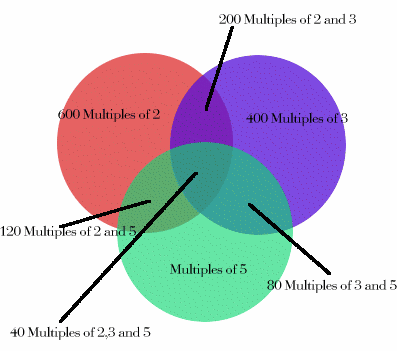
Working along the same lines, Emma and Laura from The Mount School in York sent the diagram above, and Lorn from Stamford School sent the solution below:
Simplify the problem by trying 1-30 (because 2 x 3 x 5 = 30 and 30 is a factor of 1200).
First I crossed off all the multiples of 2 (even numbers). Then I crossed off all multiples of 3, then all multiples of 5. I then counted 8 numbers which were not crossed off.
I tried 31-60 and found a pattern.
Comparing 31-60 and 1-30, the crossed off numbers corresponded.
This is not surprising since you get the numbers in the second set just by adding 30 to the numbers in the first set.
I also noticed that the numbers I did not cross off were prime numbers and 2, 3 and 5 are prime.
There are 40 sets of 30 numbers from 1 to 1200 (1-30, 31-60, 61-90 ... ).
From this I conclude that in each set there are 8 numbers that are not multiples of 2, 3 or 5, so there are 8 x 40 = 320 numbers altogether that are not multiples of 2, 3 or 5.
Lorn found another method, using similar ideas, sparked from the Venn diagram shown in the original question:
The diagram shows three sets of numbers: multiples of 2, multiples of 3 and multiples of 5.
When counting all the numbers in the three sets (600 + 400 + 240 = 1240) some numbers are counted twice and some numbers are counted 3 times.
Deducting the number of 'double counted' numbers we get 1240 - 200 - 80 - 120 = 840. Now the 'triple counted' numbers have been removed 3 times so we need to add on 40 to include them, giving 880 numbers which are multiples of one or more of the given numbers.
It follows that 1200 - 880 = 320 numbers are not multiples of any of these numbers.
Congratulations for your work on this problem to Samantha of Hethersett High School, Norfolk, Jenny, Caroline, Emma, Rachel and Beth from the Mount School, York and to Ben.
Teachers' Resources
Since this problem can be tackled in a variety of ways it can lead to useful discussions on the merits of different strategies.
If students disagree about the correct answer they can be challenged to develop convincing arguments that justify their conclusions.