

Folding Fractions


What fractions can you divide the diagonal of a square into by simple folding?
Problem
You may wish to look at Folding squares before trying this problem.
Image

Image

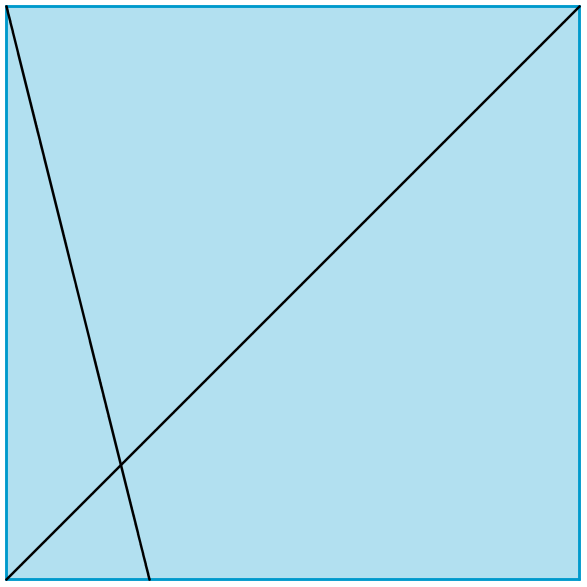
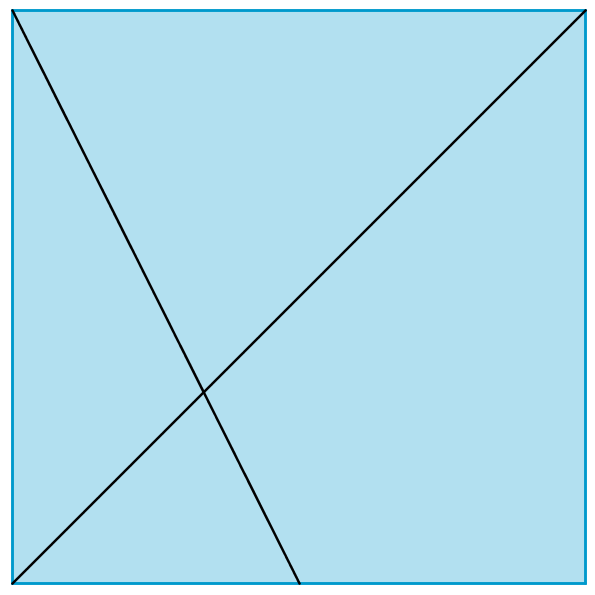
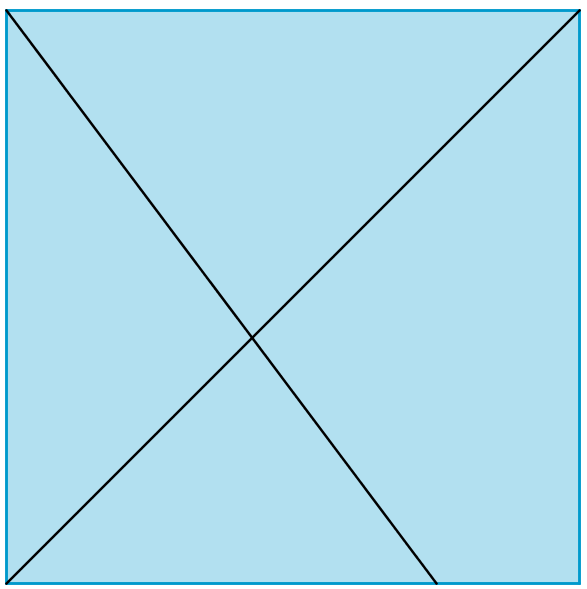
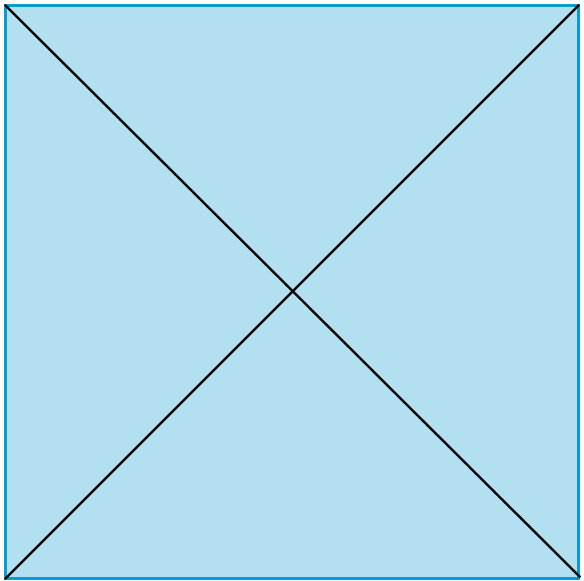
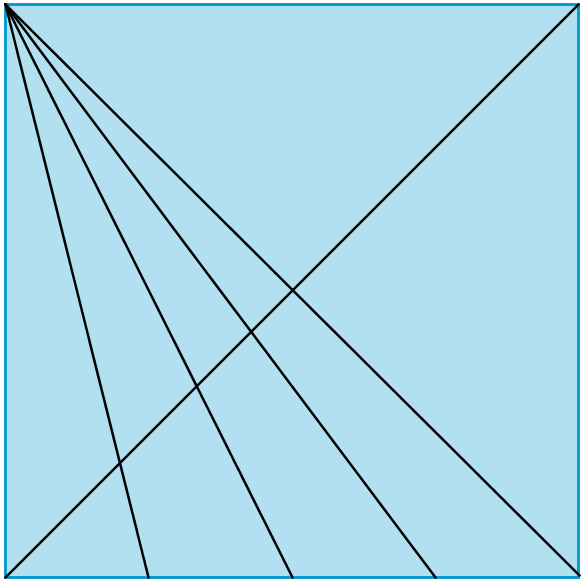
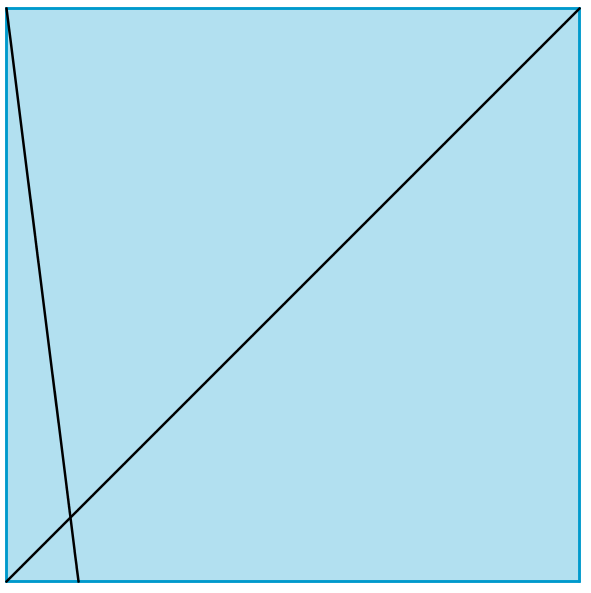
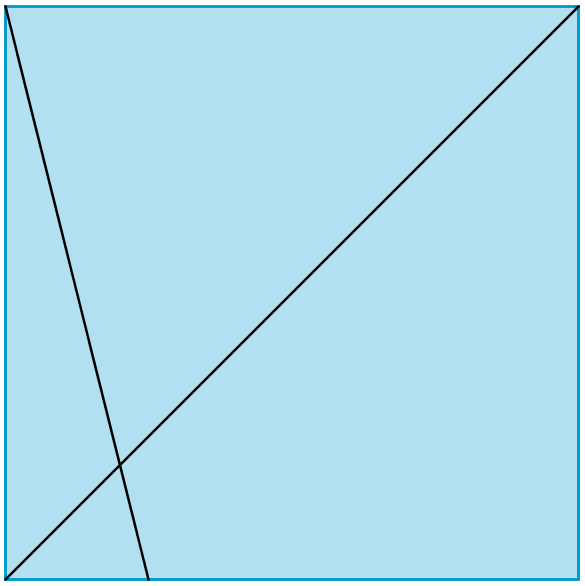
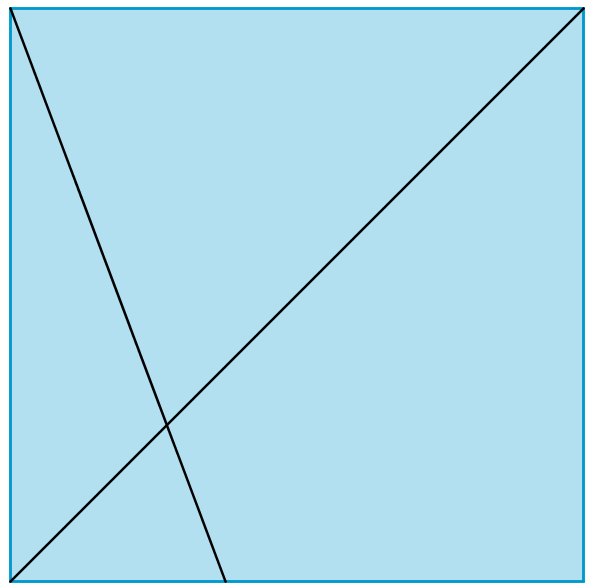
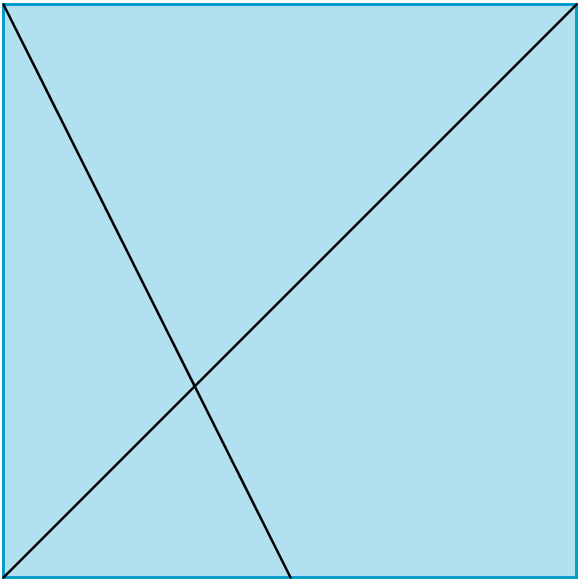
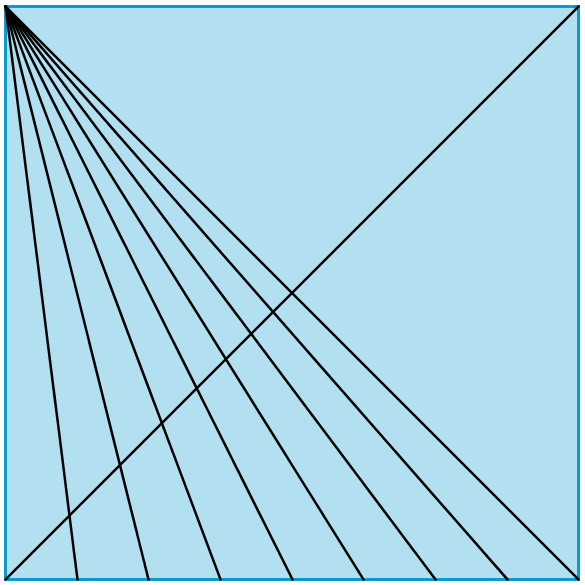
| You can divide the long diagonal of a square into different fractions by folding.
This problem is about the fractions of the long diagonal of a square which you can construct in this way.
To start with, we shall only consider points on the side of the square which can easily be found by folding. That is, $\frac{1}{2}$s or $\frac{1}{4}$s or $\frac{1}{8}$s and so on. |
...
...
Getting Started
Look for angles which are equal. Can you find any pairs of similar triangles?
Student Solutions
Richard of Mearns Castle High School sent us in this solution:

Notice that $AE = \frac{1}{n} AB = \frac{1}{n}x$
We can say that $\triangle AEF$ and $\triangle DCF$ are similar. This is because $\angle AFE$ is equal to $\angle DFC$ (vertically opposite). Also $\angle FAE = \angle FCD$ and $\angle AEF = \angle CDF$ (alternate angles).
Since the triangles are similar we can say that the ratios of corresponding sides are the same. Therefore:
$$\eqalign{
\frac {DC}{AE} &= \frac{FC}{AF}\cr
\frac{x}{\frac{x}{n}}&= \frac{FC}{AF}\cr
n &= \frac{FC}{AF}
}$$
Hence$$FC = AF \times n $$
So $DE$ cuts $AC$ at the ratio $1:n$.
Teachers' Resources
Using NRICH Tasks Richly describes ways in which teachers and learners can work with NRICH tasks in the classroom.
Why do this problem?
Relationships can be discovered by making accurate paper folds or diagrams, but there is also scope for some sophisticated geometrical reasoning, manipulation of fractions and finding and justifying general rules for the different fractions that can be made.
Possible approach
Key questions
Possible extension
Possible support
Start with Folding Squares and build up ideas about halves and quarters before trying to generalise.