

Diagonals for Area
Age
16 to 18
Challenge level


Can you prove this formula for finding the area of a quadrilateral from its diagonals?
Problem
Prove that the area of a quadrilateral is given by half the product of the lengths of the diagonals multiplied by the sine of the angle between the diagonals.
Getting Started
This only uses the result that the area of a triangle is half the base times the height but you need to consider different cases according to whether the quadrilateral is convex or concave.
Student Solutions
Tom and James from Queen Mary's Grammar School, Walsall and Shu Cao from Oxford High School gave this solution for a convex quadrilateral. Can you see how to adapt the solution for the case of the arrow shaped quadrilateral?
Image
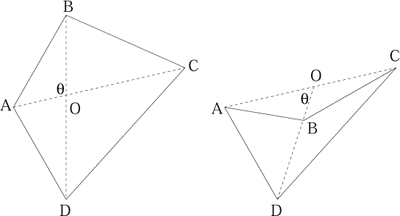
Suppose there is a convex quadrilateral $ABCD$, the diagonals
$AC$ and $BD$ cross each other at $O$. The angle between $AO$ and
$BO$ is $\theta$ degrees, the angle between $DO$ and $CO$ is the
same. The angle between $AO$ and $DO$ is $180-\theta$ degrees, the
angle between $BO$ and $CO$ is the same.
The area of triangle $AOB$ is ${1\over 2}AO\times BO \sin
\theta$.
The area of triangle $AOD$ is ${1\over 2}AO\times DO \sin
(180-\theta)={1\over 2}AO\times DO \sin \theta$.
The area of triangle $DOC$ is ${1\over 2}DO\times CO \sin
\theta$.
The area of triangle $BOC$ is ${1\over 2}BO\times CO \sin
(180-\theta)={1\over 2}BO\times CO \sin \theta$.
The area of the quadrilateral is the sum of these four
triangles.
$$\eqalign{ {\rm Area}&={1\over 2}AO\times BO \sin
\theta+{1\over 2}AO\times DO \sin \theta+{1\over 2}DO\times CO \sin
\theta+{1\over 2}BO\times CO \sin \theta \cr &= {1\over
2}[AO(BO+DO) + CO(DO+ BO)]\sin \theta \cr &={1\over 2}(AO\times
BD+ CO\times BD)\sin \theta \cr &={1\over 2}AC\times BD \sin
\theta }$$
So we have proved that for a convex quadrilateral the area of
the quadrilateral is given by half the product of the lengths of
the diagonals multiplied by the sine of the angle between the
diagonals.