

Mrs Trimmer's String

 2 out of 3
Can you help the children in Mrs Trimmer's class make different shapes out of a loop of string?
Problem
Mrs Trimmer's class had been drawing different shapes with straight sides. On Tuesday the sun was shining and Mrs Trimmer took all twenty-four of the children out into the playground. She also took some long loops of string.
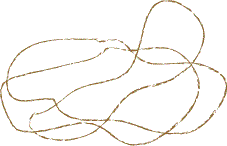
Mrs Trimmer held up one of the string loops. "How many of you will we need to make a triangle?" she asked.
She chose Ellie, Winston and Andy. They held the string tight and so made a beautiful triangle.
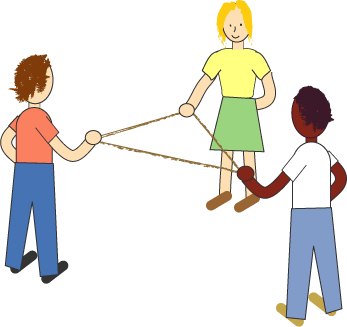
Then other children made triangles, squares, rectangles, pentagons and hexagons. Some made regular polygons and others made more irregular shapes.
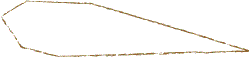
Six of the class made a shape. Nick pointed at it. "That's nearly a triangle!" he laughed. Mrs Trimmer came up. "It's still a hexagon," she explained, "It's got six sides and six people holding the corners."
After a while Mrs Trimmer called all the twenty-four children together. "Now we are all going to make triangles," she said, "So get into threes." They made lots of different ones. Some looked like these:

If all the children were making a triangle, how many triangles did they make altogether?
Then the children made four-sided shapes.
What different shapes could they have made?
Can you draw some of them?
How many four-sided shapes did the class make altogether if all the children were involved?
Then the children made hexagons and then octagons.
How many hexagons and how many octagons could the class make?
"We haven't made pentagons yet, Mrs Trimmer," complained Nick.
How do you think they managed to make five good pentagons?
Getting Started
How many children are needed for one triangle? How many children would be needed to make two triangles then?
So if there are twenty-four children, how many triangles can they make at the same time?
You could try drawing the triangles and numbering the corners to show the children.
Student Solutions
This was an engaging problem. It encouraged you to think about factors and multiples and showed how these principles may be applied to real-life situations! It also prompted you to think about different kinds of shapes.
Mrs. Heffernan's students from Paton School, Shrewsbury, Massachusetts, USA targeted this problem using the "chunking" method of division. There are twenty four students, and one group of three students makes a triangle. So, to find out the number of triangles they can make, we need to know how many groups of three there are.
Caitlin, from Deer Hill School worked out the correct answer, also noting that no-one should be left out. Nadia from Wimbledon High School and Ryan from Rhu Primary both sent excellent solutions to this problem. Nadia says:
Then for the question that asks you what different shapes could be made the answer is a square, a rectangle, a diamond and many more.
It might be better not to use the word "diamond" in maths - can you think of the mathematical names of shapes that we might think look like a diamond? Ryan suggests that parallelograms are possible too. What other four-sided shapes could we make?
Carolyn, from Pigeon Mountain Primary School suggested some four-sided shapes, including parallelograms, and rhombuses. Priya and Ashleigh, from Penrhos College also mentioned a trapezium for another four-sided shape. Mrs. Heffernan's students pointed out that a rectangle is actually a type of parallelogram; it is a special version, because all of the angles are $90^{\circ}$. Similarly a square is a special type of rhombus, with right angles.
The problem then asks about the numbers of other shapes that the class can make. Again, Mrs. Heffernan's class used the same method ("chunking") to find the answers. Nadia, and Ryan also submitted correct solutions. Ryan explains:
Like Ryan, Nadia also thought that Mrs Trimmer could join in - that's a good idea. Sarah from Greenlands Secondary School also suggested this, as did Matthew from Stambridge. Caitlin, and Margaret from Deer Hill School, and Ryan and Trystan also sent in correct solutions, with great reasoning.
Kieran from Newman Primary School, and Ebony from Gordon Primary suggested that one child could hold two corners of a pentagon, which would be another good way around the difficulty. Priya and Ashleigh suggested that four children could be left out so that four pentagons could be made.
Can you think of any other ways that the class could make shapes with the string? What if some people (or even all of them!) held two pieces of string, one in each hand? What shapes could they make? How many?
Well done, and thank you for your solutions.
Teachers' Resources
Mrs Trimmer's String
Mrs Trimmer's class had been drawing different shapes with straight sides. On Tuesday the sun was shining and Mrs Trimmer took all twenty-four of the children out into the playground. She also took some long loops of string.
Mrs Trimmer held up one of the string loops. "How many of you will we need to make a triangle?" she asked. She chose Ellie, Winston and Andy. They held the string tight and so made a beautiful triangle.
Then other children made triangles, squares, rectangles, pentagons and hexagons. Some made regular polygons and others made more irregular shapes.
Six of the class made a shape. Nick pointed at it. "That's nearly a triangle!" he laughed. Mrs Trimmer came up. "It's still a hexagon," she explained, "It's got six sides and six people holding the corners."
After a while Mrs Trimmer called all the twenty-four children together. "Now we are all going to make triangles," she said, "So get into threes." They made lots of different ones. Some looked like these:
If all the children were making a triangle, how many triangles did they make altogether?
Then the children made four-sided shapes.
What different shapes could they have made?
Can you draw some of them?
How many four-sided shapes did the class make altogether if all the children were involved?
Then the children made hexagons and then octagons.
How many hexagons and how many octagons could the class make?
"We haven't made pentagons yet, Mrs Trimmer," complained Nick.
How do you think they managed to make five good pentagons?
Using NRICH Tasks Richly describes ways in which teachers and learners can work with NRICH tasks in the classroom.
Why do this problem?
This problem gives children opportunities to explore the properties of $2$D shapes but also to apply their knowledge of dividing into equal groups.
Possible approach
Key questions
Can you think of the names of any other shapes with four sides?
Possible extension
Learners could try one of these Stage 2 problems, Bracelets or Where Are They?.
Possible support
If it is not possible to work on the problem practically using string, some children might find it useful to make the shapes with some apparatus, such as geostrips. Alternatively, they could draw the triangles and number the corners to show the children or use counters to group together to represent the children or to represent the corners of the shapes.